Showing posts with label YogaArticles. Show all posts

Wednesday, November 08, 2006

How to keep balance in yogasana?

By Kavita Maharaj
[Red Door Yoga]

A concept common to most eastern philosophies, of which yoga is no exception, is the concept of the balanced existence of male and female energy in the universe.

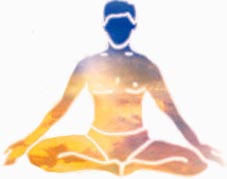
Most of us are familiar with this concept within Taoism, which is represented by the Taijitu or Yin-Yang symbol: a circle containing a balanced swirl of black with a white dot and white with a black dot. Not as many however are familiar with the concept as it appears in yoga, where the concept is represented by a sun and moon together (see illustration).

In yoga, male energy (the sun), is referred to as Shiva, and is the form of the universe. Male energy is the domain of the right side of the body. Whereas female energy (the moon), is referred to as Shakti, and is the force of the universe. The female energy is the domain of the left side of the body.

During yoga practice, the goal is to observe and understand the dance between Shiva and Shakti. In this dance Shiva and Shakti flow in balance with each other bringing balance to the physical, emotional, and spiritual aspects of the yogi.

In yoga, the concept of male and female energy continues on into the categorization of poses as well.

Female poses draw energy into the body and often physically close the body into itself, such as in a forward bend. Male poses on the other hand, expend energy and often physically open the body, such as in a backward bend.

Poses also need to be balanced by male or female breaths.

The exhale of a breath is considered the male aspect of breathing while the inhale of the breath is considered the female aspect.

When practising a male pose, a female breath (inhale) should be used to move into the pose.

If the pose is held for more than one breath, the inhale is then used to deepen a male pose.

When practicing a female pose, a male breath (exhale) should be used to move into the pose.

Likewise, if the pose is held for more than one breath, the exhale is then used to deepen a female pose.

Male and female poses should ideally be practiced in balance with each other.

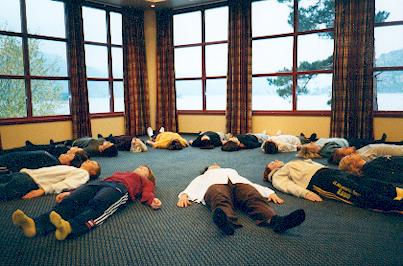
Interestingly, the pose Savasana, or corpse pose, which is practiced at the end of a physical yoga class is actually neither male nor female, but rather a balanced combination.

After your physical practice, during which Shiva and Shakti have danced in a balanced way, they come to rest together in Savasana.

Thus, while in Savasana, one should focus on a breath balanced through both an inhalation and an exhalation to maintain the flow of both male and female energy.

Friday, November 03, 2006

Yoga and Google Trends

Google Trends is an amazing tool to discover the searching trends in internet. It gives an outline of the keywords people used most often. I just check yoga searching trends from that site. Result it showed is very interesting. As we know, Yoga is originated in India. Same country is still is in eager to learn yoga. Google trends shows that Indian is first in the search for yoga. Second country is Singapore. Canad, USA and Ireland comes next with approximately equal in weight. See the result:


1. India


2. Singapore


3. Canada


4. United States


5. Ireland


6. Australia


7. Chile


8. Switzerland


9. United Kingdom


10. Sweden


While searching google trends with the keyword "Yoga", It also showed city wise Searching behaviour also. San Francisco City is top in yoga search. Delhi city in India comes 5th place. See the yoga trends:
1. San Francisco, CA, USA


2. Pleasanton, CA, USA


3. New York, NY, USA


4. Vancouver, Canada


5. Delhi, India


6. Boston, MA, USA


7. Denver, CO, USA


8. Chennai, India


9. Seattle, WA, USA


10. San Diego, CA, USA


Anyway, all the trend reslts on yoga in Google Trends Shows the increase in interest of Yoga worldwide. SEE Yoga search trends

Wednesday, November 01, 2006

A guide to Beginners in YOGA.

According to a U.S. Consumer Product Safety Commission report, there were more than 3,700 yoga-related injuries costing a total of almost $11 million in medical care in 2004. The most common yoga injuries involve repetitive strain, overstretching the neck, shoulders, spine, legs and knees.

So before you pull out that yoga mat, the American Academy of Orthopaedic Surgeons has this advice.

• Speak to a physician before participating in yoga if you have any preexisting injuries or conditions.

• Work with a qualified yoga instructor. Inquire about experience and credentials.

• Warm up well before doing yoga. Because cold muscles, tendons and ligaments are vulnerable.

• Wear clothing that allows for proper yoga movement.

• Start slowly while you learn the basics, such as proper breathing, before you see how far you can stretch.

• Ask questions if you are unsure of a yoga pose.

• Know your limits in Yoga. Do not go beyond your experience or comfort level in Yoga.

Tuesday, October 31, 2006

Ananda Yogi: A grand master on Yoga

Yogi Ananda, a 72 years old Yoga master started yoga for yogurt.


He is currently teaching the Indian spiritual yoga practice across central New York and in his home studio at White Birch Lane in Auburn. He started his Yoga Journey since his 11th age.

According to him, Yoga is his life, recreation and his socialization. His introduction to yoga came at a monastery in Bangladesh(The eastern area of India). A natural curist doctor offered Ananda a steady supply of sweet yogurt in exchange for every yoga lesson he took. The offer proved too tempting for him to resist.

But he surpassed his taste for yogurt by the his yoga passion. He wandered across India as a monk to learn more about yoga and acquire more experience. Following years of intense study that included eight years of seclusion in a Himalayan cave, Ananda began teaching at the International Yoga Teacher's Training Center in Calcutta. Aspiring yoga teachers came from around the world to be certified by Ananda. Yoga instruction also took Ananda across the globe, from Thailand and Indonesia to East Africa and Spain.


Ananda said that main aim of his life has been to spread awareness about the relation between soul and body by the practice of yoga.

In 1973, Ananda came to America at the behest of the California Board of Education. Board sponsored him to teach yoga at colleges in San Diego, Laguna Beach and San Francisco. Ananda then started yoga classes around the country. After he arrived at Syracuse University in 1974. Students and university staff encouraged him to stay there.

By the end of the decade, Ananda had established the Shankar Yoga Society in Syracuse and instructed celebrities like George Harrison, Peter Sellers and Linda Lavin at the New Age Health Spa in the Catskills.

“They mostly came to lose weight, that's not what yoga is about,” Ananda said with a lightly humorous tone.


Nowadays Ananda concentrates on teaching Yoga at Cayuga County Counseling services and companies like Bristol-Myers Squibb and The Syracuse Post-Standard. He has also conducted a course at Onondaga Community College for more than 25 years. Despite his decades of devotion to yoga, Ananda still shies away from designating himself a teacher.

“The more you learn [from yoga], the more you can then teach[Yoga],” Ananda said.

In his yoga classes, Ananda often uses the operation of a car as an organizing principle for the means of healthy human living he emphasizes. A balanced diet and plenty of water represent the proper fluid levels.

“We try to claim we're eating a balanced diet, but for most people that's a Big Mac in one hand and a large soda in the other,” Ananda said.

Lubrication amounts to rigorous, full-body exercise that loosen the joints and muscles. Breathing techniques, a facet of yoga commonly ignored by other instructors, represent the alternator in Ananda's car model. The exhaust system is comprised of bodily functions and relaxation provides people with a cooling system for the stress of daily living.

“Relaxation is in the mind; it's much more than just laying down,” Ananda advised.

Ananda's holistic approach to yoga contrasts the one-dimensional approach of other instructors. Ananda laments the rising commercialization of yoga, which he believes has brushed aside paramount aspects of the practice in favor of a chic fitness trend.

“One of these days, original yoga won't exist,” Ananda said.

Andanda's approach to yoga extends beyond the muscular flexibility mainstream yoga instructors flaunt. His yoga instruction encompasses philosophy and theology to emphasize the merger of body and mind in service of honesty and selflessness. Getting in shape is only a side effect.

“You can get exercise at the health spa,” Ananda said.

Ananda often encounters this superficial approach to yoga in his classes at OCC. Students who don't take the practice seriously will have a difficult time securing Ananda's approval.

“I want sincerity from my students,” he said.

One of Ananda's most sincere students has been Peter Mack, owner of Mack's Studios in Auburn. Mack began taking private yoga lessons with Ananda almost three years ago after hearing his name mentioned around town. A few lessons later, Mack was a full-fledged yoga convert.

“I was so enamored with it, and it was such a life-changing experience that I kept bringing new people over to try it out,” said Mack, 51.

He continues, “It basically puts all the pieces of your life together - your mind, body and spirit act as one and you feel whole. You find that all the power and the answers you could ever want are inside of you.”

Although Mack has practiced with other yoga instructors, he firmly believes that none can match Ananda's passion for yoga and dedication to its principles.

“He's here for everyone else except himself,” Mack said. “He gives his life to make others' better.”

Mack's comments echo those made about Mother Theresa, who Ananda served alongside on relief missions for victims of natural disasters in India. Today, Ananda's mission to spread awareness through yoga in Auburn begins with ridding his students' “exhaust systems” of the two snacks that repulse him most: soda and gum.

Health Benefits of Yoga

Yoga and meditation has a lot of health benefits such as management of stress, anxiety and improvement of musculoskeletal problems, physical and mental fitness.

Now there’s clinical evidence that suggests that yoga can also be used for reduction of performance anxiety and consequently, be beneficial in enhancing performance in musicians. Dr Satbir Singh Khalsa (PhD), Assistant Professor of Medicine at Harvard Medical School, who has studied the effects of yoga on a group of musicians, has gathered data that proves this.

Dr Khalsa, who was in the city for some days, said, “Musicians when performing in front of thousands of people are faced with performance anxiety. In situations such as these, the relaxation response of the body is not activated producing chronic stress. However, yoga helps them to overcome this problem in many ways.”

Combinations of yoga techniques - “pranayama” or breathing exercises, “asanas” or physical exercise and meditation - helps in the production of Cortisol hormone. This hormone is helpful part of the body’s response to stress.Further, practicing yoga also regulates the autonomic nervous system responsible for controlling stress and anxiety.

Yoga not only catering to performance anxiety, but also helps to remove stage fear through its unique mechanism. Researches on this subject reveals that yoga and meditation helps in reducing stress and the effects of stress.

For instance, Dr Satbir adds: “A research paper on Yoga by Herbert Benson published in 1972, is a strong evidence on benefits of Yoga. It gives the information that Yoga and mediation reduces the consumption of oxygen in the blood, thereby lowering the physiological activity. However, stress is known to have increase physiological activity. Hence, it proves that stress or at least effects is lowered by mediation.”

Apart from secreation of stress hormones, yoga especially if practicised before a particular performance, directs the body and mind to concentrate on a particular thought rather than waving away. Yoga thus breaks the cycle of tension which otherwise builds up in the mind causing performance related anxiety.

Monday, October 30, 2006

Yoga strengthen your Physical and Mental Health

Whether you’re looking to enhance your cycling performance or to combine the physical and spiritual aspects of your workout, yoga may be what’s missing from your life. Yoga provides balance to your whole being: physical, mental, emotional and spiritual. The question is where to begin?

Roots of yoga

Although there has been a recent surge in the popularity of yoga, scholars believe the foundation of yoga is more than 5,000 years old. Yoga was introduced in the West during the early 19th century as a movement for health and vegetarianism. By the 1960s, there was an influx of yoga schools opening in America and Europe. Today, yoga classes are abundant at health clubs and yoga studios, making it readily accessible.

A consistent yoga practice increases muscular strength and flexibility, improves balance and joint range of motion and enhances body awareness. Yoga positions engage all the joints of the body. A move as seemingly simple as downward dog increases lubrication of the joints, ligaments and tendons as well as providing an excellent stretch for the muscles.

Building a strong foundation

You’re probably thinking, "This all sounds great, but what kind of yoga is best for me?"

Central Coast yoga teacher Laura Ghiringhelli suggests you try a few classes on for size to determine which one fits.

"As far as what type of yoga for cyclists, I think it depends on the intention — endurance, breath awareness, alignment refinement, stretch and balance or spiritual growth? My Yoga for

Cyclists class is a slower-paced class, which takes the time to find alignment and breath, but some people might be more into the flowing more vigorous paced class."

Regardless of which type of yoga class you choose, you will reap amazing benefits. Just remember to listen to your body and go at your own pace. There is no competition in the yoga studio.

Some of the benefits of yoga include:

• Cross training: Yoga serves as an excellent cross-training tool to elongate chronically tight muscles while strengthening weak muscles.

• Increased core stability: Core support allows you to stay stable on the bike and achieve more power with your stride. Yoga teaches how to integrate and radiate from the core, keeping the body supported, yet relaxed.

• Improved posture: Yoga teaches proper alignment of the skeletal system as well as balance and function of the muscles. When you utilize proper alignment on the bike, you will experience greater efficiency and less muscle fatigue.

• Enhanced endurance: Breathing and visualization techniques taught in yoga allow you to focus the mind and maintain a low heart rate, making that century ride seem like a breeze.

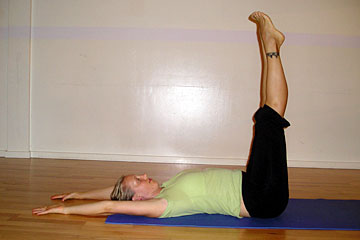
Urdhva Prasarita Padasana

[Extracted from star bulletin]
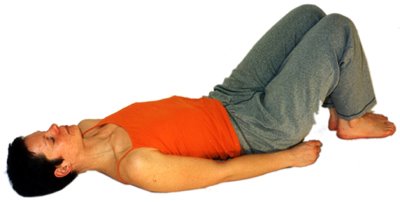
Stage 1 (Upward Expanded Leg Pose) » In this pose, the abdominal muscles are strengthened, and fat around the abdomen is reduced. The abdominal organs become toned and the back muscles are strengthened. This pose helps relieve gastric problems and flatulence.

1. Lie on the floor on your back with feet together and body straight.

2. Bend your knees and bring the feet close to the buttocks.

3. Use your hands to lengthen the buttock flesh toward the heels so the lower back feels long.

4. Stretch your arms overhead in line with the shoulders. Keep them straight and flat against the floor with your palms up. Stretch your arms so that your trunk is lengthened toward the arms.

5. Now, slowly extend the left heel along the floor, maintaining that stretch in the back until the leg is straight. Extend the other leg. Both legs should now be straight against the floor.

6. Stretch the arms and legs away from the body and feel the length in the trunk. Do not let your lower back arch.

7. Keep this stretch in the trunk as you bend your knees and take your thighs toward the abdomen. Do not lift your buttocks off the floor or allow your the back to round.

8. Now, keeping this extended spine, slowly straighten the legs until they are vertical.

9. To stretch the spine, extend the arms and press the leg bones away from the trunk. You should try and feel the same extension as you did when the legs were on the floor. Do not let the legs move away from the vertical position.

10. Hold for up to 30 seconds without strain. To come out of the pose, bend the legs, folding the knees to the abdomen, then take your feet to the floor. Rest and repeat. With practice you will be able to hold this pose in comfort, then you will be ready for Stage 2, which we will show next week.

Remember, do not let your face or eyes get tense while in this pose and breathe softly. Learn to focus on the symmetrical performance of the pose so that your mind becomes absorbed in the moment.

Yoga cures Asthma: Yes It Really Works!!!

Asthma is derived from Greek word which means "panting, gasping or short-drawn breath." It is one of the most discomforting of respiratory ailments, known to affect around 5% of the world’s adult population and 10% of children.

Tests carried out at Yoga Therapy Centers across the world have shown remarkable results in managing asthma. In some cases it has also been found that asthma attacks can actually be averted, without the aid of drugs, just through yoga practices.

Since Yoga believes that the mind is central to a diseased condition, pacifying and placating it would, in itself, help cure asthma to a great extent. The practice of yogasanas, yogic kriyas, pranayamas, relaxation and meditation calm down the whole system. This, in turn, facilitates proper assimilation of food and strengthens the lungs, digestive and circulatory system. Over a period of time, that checks asthma attacks and even cures the asthma condition.

Yogic practices result in more anxiety reduction than drugs do. Yoga gives patients access to their own internal experience and helps them pin-point the cause of their ailment, i.e find their own triggers. This comes through increased self-awareness.

Simple Yoga practices help regulate breathing patterns, as well as enhance lung functioning. As a result, asthma patients are able to manage their condition by simply allaying their fears and anxieties.

Yoga also has a stabilizing effect on the body’s immune system. It is now proven that the regular and consistent practice of yoga raises the body’s tolerance to infection as well as its local resistance to infections in the respiratory tract.

Yogic rest and relaxation reduce the nervous system’s overall activity, leading to remarkable recovery. Only Yoga offers resources like Abhyasa (regular, constant practice) and Vairagya (detachment) as means of holistic healing.

The yoga practices for asthma work best on an empty stomach, but you should continue to sip water from time to time, to help keep your airways moist. Wear light, loose-fitting clothes and practice in a comfortable, well-ventilated, airy room or outdoors, with adequate room to lie down. If you experience any symptoms lying down, sit on a chair for a while and rest your head on a table, either on your folded arms or on one cheek. If you feel nauseous, anxious, or short of breath in any of the practices, stop immediately, get up and walk around.

You are probably just hyperventilating and need to burn off some energy. Don't resume your practices right away. Rather give them a break for about a day or two.

Above all, tell yourself from time to time – particularly when you get irritated or upset with yourself – that the way you breathe now is what is making you ill. It is conditioned behavior, which can easily be altered.

SOURCE: Kevin Pederson from yogawiz.com, an online guide on yoga, fitness and wellness.

Friday, October 27, 2006

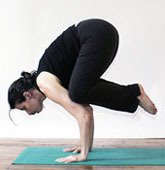
The Yoga pose Crow

The Yoga pose Crow – (Kakasana, sometimes called Bakasana) "Kaka" means crow (a large black bird with a loud cry) and "Baka" means crane (a tall water bird with very long legs).

The body in this yoga pose resembles that of a bird, thus the names, crane or crow. The Yoga pose Crow is a moderate inverted balancing posture, which builds strength in the upper extremities (arms, forearms, elbow joints, hands, wrists, clavicle, and scapula) and gives you the confidence to begin work with the Headstand and the Handstand.

The yoga pose Crow pose requires courage (to risk falling on your nose) and hip flexibility (to bring the thighs alongside the chest). The Crow is one of the yoga poses that actually looks a lot harder than it really is and it requires much more coordination, concentration and awareness than the muscular strength in the upper arms.

As you hold this yoga pose the chest is immobilized so that you can only breathe abdominally. Remember to keep your attention on the breath because this yoga pose brings the habit of holding the breath as you focus on the balancing act.

This yoga pose reinforces the arm, shoulder and abdominal muscles, wrists and the upper torso. It stretches and lubricates the joints, tendons and ligaments of the upper body. It tones the abdominal organs and opens the groins. The Crow pose increases both physical and mental balance, concentration and tranquility. It balances the nervous system, brings lightness to the body and prepares the mind for meditation.

Although the yoga pose Crow pose gives us tremendous benefits for the mind and the body, in some health conditions this pose is not safe to be performed.

Three important reasons not to do yoga pose Crow:

  • Do not practice this yoga pose if you have a carpal tunnel syndrome (a lot of pain and weakness in the fingers and wrists), as it may aggravate the problem.
  • In pregnancy do not attempt this pose.
  • If you have high blood pressure, avoid this yoga pose.

Caution: Always check with your doctor if you have any doubts or concerns regarding the suitability of this yoga pose for you.

Postures to relax the mind

Courtesy: Bharat Thakur

Sleep is not necessarily relaxation as man dreams, or continues to remain restless during the night. Rest is needed not only by the body but the mind as it works continuously without our control. You cannot stop worrying about a problem even though you know that agonising will not solve it. One way to rest our mind and body is the practice of Yoga Nidra, where a man 'sleeps' and at the same time remains aware that he is sleeping.


Yoga Exercise 1

• Lie on your back on a mat or a hard mattress
• Concentrate on your breath. Breathe deeply from the abdomen and be aware of yourself inhaling and exhaling
• There are sixteen vital points in your body which can relax you totally, if you concentrate on them. Start concentrating on the forehead, move progressively to the nostrils, lips, chin, neck, shoulders, elbows, wrists, fingertips, chest, abdomen, thighs, knees, calves, ankles and toes. Repeat this cycle twice or thrice
• Now imagine your limbs are detached from your body. Only the head, chest and abdominal area exist now. As you breathe in, feel the air entering your spine and cleansing it
• Concentrate on the different vital nerve plexus or nerve junctions called chakras’. Breathe in and out 5-10 times while concentrating on each point
• Start with the root plexus or mooladhara in the space between your anus and your genitals
• Move to the solar plexus or swadhisthan, four fingers above the navel
• Then to the midpoint of the chest, anahat
• Move to the throat, to visudhi
• Move to the point between the eyebrows, ajna
• Finally move to the crown, the suryachakra
• Imagine your limbs are once again attached to your body. Be aware of your whole body as one unit for about two minutes
• Slowly open your eyes, stretch and get up.

C

Wednesday, October 25, 2006

Yoga helps drive mosquito borne diseases

With 88 fresh cases registered taking the total number of cases suffering from dengue so far to 1,908 in the capital, Chikungunya is playing havoc in south India with over 100 deaths and over 40,000 people found infected.

Yoga has the potential to strengthen a person's immunity to fight a disease like Chikungunya, claims a Yoga instructor in Bangalore.

People who underwent yoga are not attacked by the disease, despite all their family members suffer from it. If at all they get affected by chance, it was cured within three days.

Dengue is spread by female Aedes aegypti mosquitoes, with symptoms such as fever, severe headache, joint and muscular pains, vomiting and rashes. Dengue fever, for which there is no vaccine, causes excruciating muscle and joint pains, high fever and severe headaches.

Like dengue, there is no vaccine for Chikungunya, and at best, symptoms can be countered through painkillers, intake of plenty of fluids and lots of rest.

Though the fever usually resolves on its own within three to seven days but the joint pains persist for months or even years.

Lilias Folan's experience in Yoga

BY CECILIA OLECK

[FREE PRESS STAFF WRITER]

Lilias Folan is an expert at journeys.

A renowned guru who helped introduce yoga to Americans through her PBS show, "Lilias! Yoga and You," which ran 1972-92, Folan often spends her weekends on the road conducting workshops for yoga devotees.

When she's not teaching, she's either at her home in Cincinnati or on a journey to her refuge, a 270-acre former sheep farm in Virginia that boasts a Civil War-era cabin made of chestnut logs.

But perhaps Folan's favorite journey is the one she can do anywhere, any time -- the journey into deep meditation and relaxation that she's been on for the past 40 years. She originally turned to yoga as a way to cure what she calls "the blahs."

Folan, 70, will be in Dearborn Heights this weekend to lead a workshop of classes, sponsored by the Yoga Association of Greater Detroit.

QUESTION: You're often thought of as the "first lady of yoga." Yet you got into the discipline in a thoroughly normal way. Can you tell us why you started doing yoga in the first place?

ANSWER: I began my yoga journey in the mid-'60s. Yoga was considered to be quite hippie, but that wasn't why I got into yoga. I went to my family doctor with a litany of physical ailments and he said, "Madam, there is nothing wrong with you -- you're suffering a case of the blahs. You need to exercise."

My back was aching, I had low energy -- taking care of two young sons -- I was tired all the time and smoking half a pack of cigarettes a day. ...

Yoga sounded interesting and a little different. I was curious and those are the kinds of things that bring people into yoga. In 10 weeks, I was sleeping better and in another two months my back felt stronger and six months later smoking gave me up.

Q: Now yoga is one of the most popular fitness trends out there. There are even classes that fuse yoga with other disciplines like tai chi, Pilates, etc. What do you think of its booming popularity -- and the spinoffs it has spun?

A: They're combining two traditions. I like to be clear about yoga and where it came from. It's 2,000 years old. This more contemporary use of yoga, it's fine. I just like to know my roots and where it came from. It's a deep philosophy and a science and study of itself. I've been 40 years on this journey and it's fascinating.

Q: What do you think it is about yoga that someone could practice for a lifetime and not grow out of it?

A: Isn't that interesting? I look at what you just said in wonderment myself and ask the same question. My feeling is that we have a deep wisdom in us that is dormant and it's young. As the years go by wisdom begins to deepen. ... That's the beauty of aging.

How many times can you do a downward facing dog, the basic pose of yoga? Well, it's deepened. There's a wisdom that has deepened as we practice.

By wisdom I mean that if there is an anger or fear that comes up, I can let it go by. I don't have to hold onto it.

Q: You focus a lot on helping middle-aged and older people discover yoga and your most recent book is "Lilias! Yoga Gets Better with Age" (Rodale, $22.95). What are some of the benefits?

A: What I do is say mid-aged and beyond. I'm sensitive about that. ... I have older students and I have students of all ages, size and shapes and all degrees of experience and I love that. I want to help people take the first steps with yoga.

It's easier to walk, stand, sit and sleep. ... I think mid-aged and beyond are looking at ways to maintain our health in our maturing years.

Q: What should someone look for in a good yoga instructor?

A: If you feel well and happy and energized at the end of the yoga class, chances are you are in good hands. In today's yoga world, many teachers are registered with the Yoga Alliance and that requires 200-500 hours of study. I'm a member of that. I'm an E-500 registered yoga instructor.

Q: What is a 1-minute vacation?

A: It's an experience that I bring into a yoga class. You just close your eyes and go into vacation mode.

What do you do when you're on vacation? If you're on vacation, you sigh, you say, "Isn't this pleasant?" You smile. For 30 seconds you just are on this desert island and it's the oasis within you.

Q: How often do you recommend that people do that?

A: If we think about it once a day, we're doing darn well. That's the good part of our yoga classes -- taking some nourishing part like that and putting it into your life.

Q: What would people be surprised to know about you?

A: One, I love to learn Italian. I love Italy and I love the language and I study Italian. Two, I love opera. I love to study opera and I love learning about it. Those are two of my passions. And I guess it's pretty obvious -- I adore my seven grandchildren.

Q: How has the practice of yoga changed over the years?

A: Big changes, big changes. One is that in the '60s everyone did the yoga postures the same way ... every age, no matter what, everyone did the postures the same way.

And frankly there were a lot of injuries. And that's where my teaching started to flower because I could see that there were problems.

Today there is alignment, props, consideration for age, yoga therapy. ... Now today there are many cautions. "If you can, do it this way, try it this way." There's also a huge respect from the medical community for the value of yoga postures, breathing and relaxation in managing stress.

It really is detrimental to your health to stay in a toxic body. And it's easy to turn around and it's fun. ... I want to have a good time. The joy is in the journey.

Monday, October 23, 2006

Yoga and Ayurveda in Addiction Treatment

By Catherine O’Neill
[Clinical Ayurvedic and Pancha Karma Specialist, Certified Sivananda Yoga Instructor.]

Our opportunity for genuine spiritual fulfillment is strengthened when we weave together the ancient wisdom of Yoga and Ayurveda with the practical tools of recovery programs; together they offer us a truly empowering personal program of recovery.

Ayurveda vi
ews the each individual as a unique expression of the five elements, refined into 3 essential doshas (Vata – air, Pitta – fire, and Kapha – earth/water). Knowledge of your Ayurvedic constitution can be of great benefit in recognizing your addictive behaviors and the needs and vulnerabilities that underlie them. Vata types are prone to addiction and they are the most easily and severely damaged by them. They usually become addicted to substances that reduce their pain, worry, anxiety and insecurity. Pitta people adopt addictions that keep them at the high level of intensity and activity that they associate with success. Pitta people tend to be self-righteous and have a hard time recovering unless they are convinced it is in their best interest. Kapha people may use substances to stimulate them as they tend toward lethargy and often fall into food addiction because of poor eating habits. These individuals have the strongest systems and can take more abuse from bad habits. Consequently, they have the hardest time recovering.

By understanding your Ayurvedic constitution, you can learn the areas in which you may become vulnerable when you are under stress – and you can determine what kinds of activities and changes in your lifestyle can best help you restore balance in mind and body. Ayurveda offers simple and practical methods to maintain health and prevent disease through the use of such tools as proper daily and seasonal routines. It revitalizes the body’s systems and boosts the immune system giving you a strong foundation in health to face the challenges and stresses of daily life without resorting/relapsing into old addictive behaviors.

“All addictions are part of a psychological pattern of dependency. This must be addressed through efforts to contact the true Self that is independent and transcends environmental influences.” - Dr David Frawley in Ayurvedic Healing. Affirmation of, and identification with the Self removes all cravings, sense of lack, self-esteem problems and self-defeating behaviors.

These Yogic paths towards Self-realization are revealed through the practice of the 5 principles of Yoga as summarized by great Yoga Master Swami Vishnu devananda:
1. Asana practice;
2. Pranayama (breathing exercises);
3. Relaxation;
4. Proper Diet; and
5. Positive Thinking and Meditation.
ASANA PRACTICE
Yogic physical exercises are designed to develop the body, broaden the mental faculties and the spiritual capacities. Yoga exercises improve the health of the spine and aid the proper function of the internal organs. They also work on the nervous system and the endocrine system (glands and hormones) therefore restoring health and balance to the entire system. It is important to note that asana practice denotes moderate, conscious, gentle exercises promoting calmness and helping to move and balance the prana (vital life force), thus breaking the stagnation and imbalances caused by drug and alcohol abuse.

PRANAYAMA (Breathing Exercises)
Breathing techniques, like deep abdominal breathing, help to balance and calm the mind - increasing mental clarity and alertness and can be practiced at any time. Most people take shallow breaths into the chest alone, deep breathing can deeply nourish and calm the central nervous system and is an essential tool in overcoming any addiction.

RELAXATION
Yogic relaxation practices are useful in reducing mental tension and anxiety. Due to the over-stimulation of the body through drugs and alcohol often there are problems with nervous energy and insomnia. Simple techniques like Savasana (corpse pose) with auto-suggestion relaxation, (tensing then relaxing each part of the body progressively from toes to head), mentally repeating “I am relaxing my toes, feet, legs, back etc”, can be taught and practiced for 10-15 minutes daily to calm and stabilize the body and mind. The ability to consciously relax the body and mind is a great practical way to increase self-esteem and self-confidence.

POSTIVE THINKING AND MEDITATION
To overcome any disorder of the mind it is important to understand how the mind works. For those who have problems with addiction, basically the mind is out of control. Addiction is the nature of the mind – it attaches to a thought and then has the tendency to repeat it over and over again – its mechanics are habitual. Addiction is simply a negative habit/association – the mind associates that alcohol/drugs are a solution and habitually jumps to this wrong conclusion – it gets into a loop and it is difficult to get out. Positive thinking and meditation offer techniques to slow the mind down so its habit can be changed – the initial aim is to increase the lapsed time between the craving, habitual thought and the action. These mental techniques help to straighten out the mind, bringing simplicity and clarity by replacing negative thinking and emotions with opposite positive thoughts and attitudes.

The mind of the alcoholic/drug abuser is addictive, obsessive, compulsive and dysfunctional. They need to relearn things with people who are already healthy, who know where happiness lies and who are strong. They need to have the courage to face the problem and this is easier when they are with those who have courage, truth, love and compassion. Unconditional support is required - people who will encourage them on their new path.

These practices, done on a daily basis, a little at a time are the necessary strategy to bring back wholeness and health and combat addiction which is a symptom of unwholenessness. The variety of practices helps the person to have choices in daily life whilst maintaining healthy boundaries, promoting progress in self control, positive attitude and lifestyle.

Combining the 5 Points of Yoga, the Yogic psychology of how to deal with the mind and the Yogic philosophy of the Self with the practice of the principles of the 12 steps alongside an Ayurvedic lifestyle offers a sure path from self-destruction to Self-realization - one day at a time.

This powerful combination can be experienced in depth at “Yoga of Recovery” retreats offered at various locations worldwide. The retreat comprises yoga asana, Pranayama and relaxation classes, positive thinking techniques and meditation instruction, Ayurveda workshops and daily Open 12 Step meetings.

[Extracted from HealthNewsDigest.com

Eliminate stress with yoga


PRACTISING yoga, the ancient art of relaxation at the workplace is effective in managing stress among the workers, a prominent yoga trainer for the corporate world, Nikhil Desai said today.

He said stress is one of the main silent killers among city dwellers today and a major factor that caused the decline in people's performance and productivity.

``The increasingly demanding modern lifestyle in this fast changing world has caused many people to be constantly under pressure to perform and achieve excellent results in their work. But instead of performing and achieving goals, stress strains energy. It kills productivity, physical well-being and relationship,'' he said in an interview at the 35th International Federation of Training and Development Organisation Conference and Exhibition 2006, held at the Kuala Lumpur Convention Centre, where he had conducted an interactive workshop on managing stress. Desai, 47, who is a qualified yoga practitioner for 20 years said practising certain yogic postures and breathing techniques not only helped calming body and mind, but also improved memory concentration, boost self confidence and positiveness, enhanced work efficiency and productivity. ``It is beneficial to both employers and employees. Managing stress well creates happy personnel and a harmonious working environment thus helps to increase an organisation's performance and success,'' he said. The Mumbai based trainer has 17 years of experience in training and development in a wide scope of training such as stress management, personal excellence, leadership and achieving work-life balance.

He has been conducting such training to more than 350 companies around the world such as AC Nielsen, Barclays Bank, GlaxoSmithKline, Ernst & Young and Cadbury. He said the yoga techniques that he introduced to his clients were simple form of exercise that can be performed anywhere and anytime.

``The yoga techniques that we use are modified to suit today's busy executives' lifestyles. They are designed to get the best results in the shortest time. Our techniques are unique because they are fun, easy to learn and perform, and time saving. There is no equipment required and practitioners can also do the simple techniques at their work station or wherever they are,'' he said.

Yoga- An explanation from James Tasse


By JAMES TASSE
[The director, Rutland Area Physical Activity Coalition.]

What do you think of when you hear the word yoga? Skinny hippies chanting as they twist themselves into uncomfortable positions? A lot of breathing? Tights? Saffron robes?

The truth is that yoga is a great way to build strength, balance, focus and flexibility. It can be as hard or as easy on the body as you want. You can do it almost anywhere. It's a great activity to try, whether you're just beginning to adopt a physically active lifestyle or maintaining some extreme sport habits.

What is commonly called yoga is technically "hatha yoga," the "physical path" of an eastern philosophical tradition that seeks to tone and unite the mind and body. The most basic practice of hatha yoga in America involves assuming postures, or "asanas," to improve strength and flexibility. Traditionally, special breathing techniques are used at the same time the postures are held to increase their effects on the body and mind.

If it all sounds too spiritual for you, don't worry. It doesn't have to be. Yoga can just be a great form of workout. But as with karate, people often wind up digging deeper into the practice once they start.

The yoga postures or asanas range from the ridiculously simple Corpse Pose for relaxation, to the advanced, arm-burning Forearm Stand. Some asanas require twisting or folding actions that stretch different parts of the body to build flexibility.

Most of the postures in Yoga require some balance, which is (thankfully) developed inevitably as a person attempts the practice. Strength is built by lifting, and supporting, the body's own weight. Learn the right yoga postures and you can get a workout that feels like circuit weight training. Except that with yoga, you'll always have your weights with you.

One of the best things about yoga is that a practice can be a crushing muscle burner or a soothing flex and stretch session.

While some forms of yoga, like Ashtanga and Bickram, are definitely more strenuous than others, you decide the level of intensity of your practice.

An important principal of yoga involves paying attention to your body and not hurting yourself by pushing beyond comfortable limits. That's one reason why yoga so perfect for people who are just starting to be active. Yoga can be slow and mellow, or active and tough.

The best way to discover yoga is to take a class. Yoga classes seem to be offered everywhere, from recreation departments to private studios nowadays. It shouldn't be hard to find a yoga class in your part of Vermont. The nice thing about a class is that there is an instructor who can work with you to provide guidance on the postures.

It's important to learn a bit more about a class you're considering attending so that you get one that's a good fit. The gentler forms of yoga include Viniyoga, Kripalu and Iynegar. Tougher forms include Ashtanga, in which certain poses are actively moved through in sequences called "vinyasas," and Bickram, which is practiced in warm rooms. Iyengar style is good to begin with, as the classes emphasize good technique and bodily alignment as you assume the postures.

Start easy. If the postures seem too easy or too hard, ask the instructor for ways to increase or decrease intensity. Every form has variations that can adjust the difficulty. But you don't need to push it too hard, at least until you know what to expect.

If you are in an area where it's too hard to get to a class, consider trying yoga with the aid of a video. There are many good yoga videos out there offering introductions to the practice. Try to find one which offers 30-60 minute sessions for beginners. Rodney Yi and Ali McGraw both offer short, easy-to-moderate intensity tapes. David Swenson's tapes are longer and more strenuous and assume you have some familiarity with the postures.

Just don't make the mistake of thinking yoga is too hard for you — or too easy. It can be part of a spiritual practice or a pure body work out.

Yoga is a great form of activity that can be done anywhere and it provides a nice alternative to weight rooms and gyms when the weather turns nasty. Namasté!

Sunday, October 22, 2006

Yoga and Work Motivation- A report

By JOHN GAPS III
REGISTER COLUMNIST

October 19, 2006

Yoga and Game

Want to improve your golf game and play better when traveling, all without taking a lesson, putting or hitting any balls?

That’s a tall order, but it might be possible if you visit www.yogaforgolfers.com. I’m not going to feed you a bunch of New Age hogwash: Yoga is no miracle cure, and while I have been practicing yoga for several years, I always dismissed the various golf yoga programs I have seen at resorts around the country. Why? Because the big myth of yoga for golf is that it improves your flexibility, and since everyone wants to hit it longer, many people look at it as a ticket to a better shoulder turn and more distance. If this is your goal, forget it. You are better off with a few good stretches in your bedroom each morning. Yes, regular yoga practice over time can increase your flexibility, but for many people it does not, because yoga was not invented to make people flexible.

What I’ve come to appreciate is that yoga can improve your golf game simply because the two have a lot in common. Here’s the deal: real yoga positions require you to do a million things at once, like pressing down the outside of one foot and the inside of the other while externally rotating one hip and internally rotating one thigh while focusing on your ankles and your rib cage while stretching your neck, that sort of thing. If you think about it, the issues sounds a lot like the golf swing, teaching yourself to do a lot of independent yet related motions all at the same time without short-circuiting the brain. All this builds muscle control and balance. It also focuses on stabilizing the lower body in most postures. That’s why doing yoga on a regular basis is good for golf.

But there are some shortcuts. Katherine Roberts, the founder of Yoga For Golfers, which she has been teaching for more than a decade, is a fixture on the Golf Channel as a hostess on several shows including The Big Break. Because Roberts travels all the time, teaching yoga clinics and shooting TV shows and playing golf, she often flies into town late and tees off early and has developed her own ten minute routine for adjusting the body to the abrupt shift from tarmac to tee. She shares her quick tips, as well as 8-minute pre and post round routines, in her latest DVD, “Lower Your Score,” her tenth in the yoga golf series, I had the good fortune to take one of Katherine’s yoga classes and then to play eighteen with her at the Sagamore, a resort with a classic Donald Ross course in upstate New York, and I can attest that her methods not only make you feel better while playing, in her case they make you look better to.

Purvottanasana in Yoga


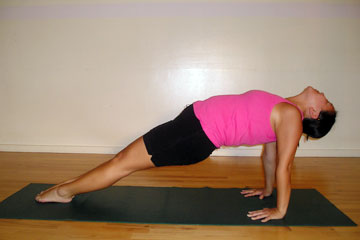
Purvottanasana belongs to the clan of backward extensions and this week we show the completed pose.

"Purva" means the "east" or "front side" of the body. "Uttana" means "intense stretch." In this pose, the back of the body is extended and contracted while the front of the body is open and stretched.

This pose brings vigor to the spine and a sense of rejuvenation to the spirit. It helps relieve stiffness in the back after practicing forward bending asanas. The shoulders are stretched and opened and the wrists are exercised.

1. Sit on the floor with your legs stretched out straight in front.

2. Place your hands a few inches behind the buttocks, shoulder width apart. Point your fingers forward.

3. Press your palms down to straighten the arms. Rotate the upper arm bones out to lift and fully open your chest, then look at your chest.

4. Keep this open chest as you press your big toe mounds into the floor and lift your entire body up with an inhalation.

5. Lift your buttocks without letting your hips sag. Keep your arms straight. Distribute the weight evenly on your hands and feet.

6. Reaffirm the lift of your chest as you take your head back.

7. Lift the sides of the chest up and keep the shoulder blades into the back so that your shoulders do not round.

8. Now breathe evenly through your nose, feeling an even opening across the front of the body.

9. Stay for a few breaths, exhale and come down. Repeat a few times, working to increase flexibility and stability in the pose while maintaining evenness in the arch of the spine.

Yoga and Indian army

Kavita Suri discovers the new mantra being practised by the Indian army soldiers posted at Siachen Glacier, the world’s highest and coldest battlefield


Do you belong to that generation of young Indians who, after getting inspired by yoga guru Swami Ramdev, have made the ancient Indian health tradition a part of their modern-day stress-filled lives? If yes, needless to ask how yoga has worked wonders for you.
Though it is gaining popularity in recent times, the sages and rishis have been practicing it since aeons at the high peaks of the Himalayas.
And when part of these Himalayan ranges turn into the world’s highest and coldest battlefield, the army has to ensure its troops remain in good health and endure extreme weather conditions. Perhaps, this is the reason why the Indian army has adopted yoga for its troops in the Himalayas.
At heights ranging from 11,000 to 21,000 feet with temperatures that can plummet to minus 60 degrees Celsius, the army troops have started yoga for the past few months at the Siachen Glacier, which is the world’s highest battlefield and also in some other parts of Ladakh.
For keeping good health, yoga is a good option especially since any rapid training exercise in the rarefied air with very low oxygen concentration can lead to physical disorders. Soldiers posted on the icy mountains of the Siachen glacier are exposed to the physical extremes of high altitude and hypoxia, besides the psychological stresses of isolation, monotony, separation from family etc.
In such circumstances, yoga can prove to be very beneficial.
“We recently trained our first batch of soldiers in collaboration with the Morarji Desai Institute of Yoga, New Delhi,” informs Lt. Colonel H. Himashree, Officer in-charge, High Altitude Medical Research Centre (HAMRC), 153 General Hospital of the 14 Corps which is the highest multi-specialty hospital in the world.
Himashree who specialises in high altitude medicine and extreme cold conditions elaborates that they have trained various army units in Ladakh with the help of yoga instructors. These trained soldiers have gone back to their respective units and are now imparting yoga training to other soldiers.
“We are trying to make every unit self-sufficient as far as yoga is concerned,” she says, adding the two month-long training has been especially designed by HAMRC with DRDO (Defence Research and Development Organisation).
There are certain things the soldiers are not supposed to do in high altitude areas when they are inducted in these areas which they however, do not know.
So, nothing is better than a tailor-made yoga package on the dizzy heights of Siachen. The boys also undergo exams, which are both written and practical as well. When they pass it, they become trainers.
Till now, they have trained 102 trained boys with the help of instructors from Moraraji Desai Institute of Yoga, New Delhi at Karu, Partappur, Kumbathang and other areas in Ladakh with different units. These boys are now successfully imparting yoga lessons to the troops in different forward areas in Ladakh.
It is a combination of ‘pranayama’ and ‘asanas’ and meditation.
But even after the training, how successful is the course or training on the glacier where even taking a single step is a big strain in itself?
“Among all the asanas – Surya Namaskar, Pawan Mukhtasana, Padamasana, Dhanurasana, Halasana, that the troops practice at high altitude areas of Ladakh, Pranayama was found to be very useful to the soldiers at the glacier’s top,” says Colonel Himashree.
Five minutes of pranayama, i.e. deep breathing, alternate nostril breathing and abdominal breathing; and five minutes of meditation is working wonders for the troops posted on the world’s highest battlefield.
Confirms an officer Lt. Saurabh Tripathi who has just been de-inducted from Siachen glacier:
“As there is very small space available inside the posts on the top of the glacier, of all the Asanas and forms of Yoga, ‘Pranayama’ is proving to be very helpful. And for that, you don’t need to have more space”.
As the HAMRC is monitoring the progress of the soldiers, the feedback that they get is that Yoga is extremely helpful in high altitude areas.
Those who practise it are well but those who are not are suffering health wise, says Colonel Himashree.
As most of the soldiers give up smoking and alcohol before getting inducted, yoga certainly helps them in maintaining good health for those three months when they are posted here,” informs Brigadier Om Prakash who heads Siachen Brigaden based at Pratappur. Their physical fitness level increases and mental faculties get sharpened.
Yoga reduces wear and tear of the heart and the HAMRC says that its results show that it produces mental tranquillity, greater alertness, flexibility and enhanced tolerance to cold.
“Our objective is the soldier’s ability to survive and efficiency especially on the Siachen glacier where only half as much oxygen as the sea level is available, and the temperatures dip to minus 60 degrees Centigrade,” says Brigadier Om Prakash.
He adds that keeping the troops healthy and fighting fit under such adverse environmental conditions calls for detailed insights into human physiology at extreme altitudes and yoga seems to be the best option in those heights.