Monday, October 30, 2006

Yoga strengthen your Physical and Mental Health
Whether you’re looking to enhance your cycling performance or to combine the physical and spiritual aspects of your workout, yoga may be what’s missing from your life. Yoga provides balance to your whole being: physical, mental, emotional and spiritual. The question is where to begin?

Roots of yoga

Although there has been a recent surge in the popularity of yoga, scholars believe the foundation of yoga is more than 5,000 years old. Yoga was introduced in the West during the early 19th century as a movement for health and vegetarianism. By the 1960s, there was an influx of yoga schools opening in America and Europe. Today, yoga classes are abundant at health clubs and yoga studios, making it readily accessible.

A consistent yoga practice increases muscular strength and flexibility, improves balance and joint range of motion and enhances body awareness. Yoga positions engage all the joints of the body. A move as seemingly simple as downward dog increases lubrication of the joints, ligaments and tendons as well as providing an excellent stretch for the muscles.

Building a strong foundation

You’re probably thinking, "This all sounds great, but what kind of yoga is best for me?"

Central Coast yoga teacher Laura Ghiringhelli suggests you try a few classes on for size to determine which one fits.

"As far as what type of yoga for cyclists, I think it depends on the intention — endurance, breath awareness, alignment refinement, stretch and balance or spiritual growth? My Yoga for

Cyclists class is a slower-paced class, which takes the time to find alignment and breath, but some people might be more into the flowing more vigorous paced class."

Regardless of which type of yoga class you choose, you will reap amazing benefits. Just remember to listen to your body and go at your own pace. There is no competition in the yoga studio.

Some of the benefits of yoga include:

• Cross training: Yoga serves as an excellent cross-training tool to elongate chronically tight muscles while strengthening weak muscles.

• Increased core stability: Core support allows you to stay stable on the bike and achieve more power with your stride. Yoga teaches how to integrate and radiate from the core, keeping the body supported, yet relaxed.

• Improved posture: Yoga teaches proper alignment of the skeletal system as well as balance and function of the muscles. When you utilize proper alignment on the bike, you will experience greater efficiency and less muscle fatigue.

• Enhanced endurance: Breathing and visualization techniques taught in yoga allow you to focus the mind and maintain a low heart rate, making that century ride seem like a breeze.

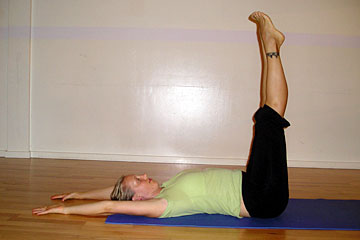
Urdhva Prasarita Padasana

[Extracted from star bulletin]
Stage 1 (Upward Expanded Leg Pose) » In this pose, the abdominal muscles are strengthened, and fat around the abdomen is reduced. The abdominal organs become toned and the back muscles are strengthened. This pose helps relieve gastric problems and flatulence.

1. Lie on the floor on your back with feet together and body straight.

2. Bend your knees and bring the feet close to the buttocks.

3. Use your hands to lengthen the buttock flesh toward the heels so the lower back feels long.

4. Stretch your arms overhead in line with the shoulders. Keep them straight and flat against the floor with your palms up. Stretch your arms so that your trunk is lengthened toward the arms.

5. Now, slowly extend the left heel along the floor, maintaining that stretch in the back until the leg is straight. Extend the other leg. Both legs should now be straight against the floor.

6. Stretch the arms and legs away from the body and feel the length in the trunk. Do not let your lower back arch.

7. Keep this stretch in the trunk as you bend your knees and take your thighs toward the abdomen. Do not lift your buttocks off the floor or allow your the back to round.

8. Now, keeping this extended spine, slowly straighten the legs until they are vertical.

9. To stretch the spine, extend the arms and press the leg bones away from the trunk. You should try and feel the same extension as you did when the legs were on the floor. Do not let the legs move away from the vertical position.

10. Hold for up to 30 seconds without strain. To come out of the pose, bend the legs, folding the knees to the abdomen, then take your feet to the floor. Rest and repeat. With practice you will be able to hold this pose in comfort, then you will be ready for Stage 2, which we will show next week.

Remember, do not let your face or eyes get tense while in this pose and breathe softly. Learn to focus on the symmetrical performance of the pose so that your mind becomes absorbed in the moment.

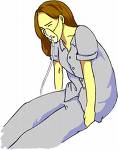
Yoga cures Asthma: Yes It Really Works!!!

Asthma is derived from Greek word which means "panting, gasping or short-drawn breath." It is one of the most discomforting of respiratory ailments, known to affect around 5% of the world’s adult population and 10% of children.

Tests carried out at Yoga Therapy Centers across the world have shown remarkable results in managing asthma. In some cases it has also been found that asthma attacks can actually be averted, without the aid of drugs, just through yoga practices.

Since Yoga believes that the mind is central to a diseased condition, pacifying and placating it would, in itself, help cure asthma to a great extent. The practice of yogasanas, yogic kriyas, pranayamas, relaxation and meditation calm down the whole system. This, in turn, facilitates proper assimilation of food and strengthens the lungs, digestive and circulatory system. Over a period of time, that checks asthma attacks and even cures the asthma condition.

Yogic practices result in more anxiety reduction than drugs do. Yoga gives patients access to their own internal experience and helps them pin-point the cause of their ailment, i.e find their own triggers. This comes through increased self-awareness.

Simple Yoga practices help regulate breathing patterns, as well as enhance lung functioning. As a result, asthma patients are able to manage their condition by simply allaying their fears and anxieties.

Yoga also has a stabilizing effect on the body’s immune system. It is now proven that the regular and consistent practice of yoga raises the body’s tolerance to infection as well as its local resistance to infections in the respiratory tract.

Yogic rest and relaxation reduce the nervous system’s overall activity, leading to remarkable recovery. Only Yoga offers resources like Abhyasa (regular, constant practice) and Vairagya (detachment) as means of holistic healing.

The yoga practices for asthma work best on an empty stomach, but you should continue to sip water from time to time, to help keep your airways moist. Wear light, loose-fitting clothes and practice in a comfortable, well-ventilated, airy room or outdoors, with adequate room to lie down. If you experience any symptoms lying down, sit on a chair for a while and rest your head on a table, either on your folded arms or on one cheek. If you feel nauseous, anxious, or short of breath in any of the practices, stop immediately, get up and walk around.

You are probably just hyperventilating and need to burn off some energy. Don't resume your practices right away. Rather give them a break for about a day or two.

Above all, tell yourself from time to time – particularly when you get irritated or upset with yourself – that the way you breathe now is what is making you ill. It is conditioned behavior, which can easily be altered.

SOURCE: Kevin Pederson from yogawiz.com, an online guide on yoga, fitness and wellness.

Saturday, October 28, 2006

Kriya Yoga can help in busting stress- Swami Nityananda Giri

VIJAYAWADA: Kriya Yoga can help in busting stress and the yogic system enunciated by Paramahamsa Yogananda has great relevance for the mankind, said Swamy Nityananda Giri of Yogoda Satsanga Society of India, Ranchi.

Speaking at an inaugural session of the three-day programme of Yogoda Satsanga Dhyana Mandali at TTD Kalyana mandapam here on Saturday evening, he said Kriya yoga was a scientific method of yoga.

Unlike other yogas, Swami Yogananda gave a simple ten-lesson module on how to practice yoga, he said and added that this would help the people in attaining peace and happiness by life energy relaxation.

Friday, October 27, 2006

Free work shop on Yoga

A free workshop on Yoga this weekend in Halifax will explore alternative approaches to physical and mental health.

"Right away, Yoga filters out or excludes a lot of people," Dr. Sodhi, a Halifax psychologist and psychotherapist, said Thursday.

"What we want to do is reach those people who would otherwise not be able to attend workshops like this."

For the first workshop, which runs from 9 a.m. to 4 p.m. Saturday at the Captain William Spry Centre in Spryfield, Dr. Sodhi has lined up three local experts to talk about the importance of tying together one’s spirit, mind and body with the help of yoga.

Dr. Sodhi’s wife, Satpal Kaur Sodhi, will lead a session on using Kundalini yoga to harmonize your endocrine system.

Dr. Jasmeet Chawla, a kidney specialist at Dalhousie University, will speak on controlling hypertension through yoga and meditation.

Dr. Timothy Walker, a Halifax psychotherapist, will talk about how stress-reduction exercises can integrate the body, mind and spirit by using yoga.

All three Yoga presenters agreed to provide their services free, Dr. Sodhi said.

"It will be very relaxed, very down to earth with simple language, very open," he said of the workshop. "After the three yoga sessions are over, the presenters will be available to answer yoga related questions."

Dr. Sodhi said he is confident that participants will leave the yoga workshop feeling better about themselves and eager to take part in future yoga sessions.

"I firmly believe that in every life there has to be a little bit of mysticism," he said. "Otherwise, what happens is you are automatized, you are caged, you are culturally conditioned, and you miss something that we call fathomlessly strange, the other kind of seeing."

About 20 people have registered for the yoga workshop so far, Dr. Sodhi said. He said any interested adults or teens can just show up at the Spry Centre. All they need to bring is a yoga mat, blanket and pillow. Lunch will be served.

Dr. Sodhi, 73, said the yoga workshop is an opportunity for the Sikh society to give something back to the people of Nova Scotia.

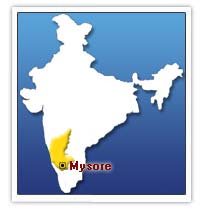
Mysore, a yoga destination for foreigners

The Mysore city has turned into a centre for yoga activities attracting thousands of yoga students and tourists from abroad. Foreigners are interested in practicing yoga from Mysore based yoga centres.

They are arriving in batches to Mysore and Bangalore to learn yoga.

Mysore city alone had 1500 foreigners between September and March to learn yoga from reputed yoga teachers in more than 50 centres spread across the Mysore city. While a few tourists stay one to three months, others stay six months to learn yoga and also teach it in their home country.

Yoga teacher K Raghavendra R Pai said that yoga has gained popularity in recent years. He said that there are more than 100 yoga centres in Bangalore, but the majority come for various reasons, including availability of accommodation, low cost of living and roads free of congestion.

The erstwhile Maharaja Nalwadi Krishnaraja Wadiyar had promoted yoga, he said.

The valedictory function of the Dasara yoga walk will be held on October 29 at 4 pm.

Sri Shivarathri Deshikendra Swamiji will preside over the function. District in-charge Minister D T Jayakumar will release a souvenir. MLA M K Somashekar will preside.

He said that more than 5000 people will participate in the Yoga Walk marathon or Yogathan.

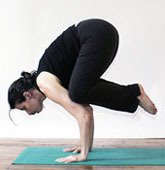
The Yoga pose Crow

The Yoga pose Crow – (Kakasana, sometimes called Bakasana) "Kaka" means crow (a large black bird with a loud cry) and "Baka" means crane (a tall water bird with very long legs).

The body in this yoga pose resembles that of a bird, thus the names, crane or crow. The Yoga pose Crow is a moderate inverted balancing posture, which builds strength in the upper extremities (arms, forearms, elbow joints, hands, wrists, clavicle, and scapula) and gives you the confidence to begin work with the Headstand and the Handstand.

The yoga pose Crow pose requires courage (to risk falling on your nose) and hip flexibility (to bring the thighs alongside the chest). The Crow is one of the yoga poses that actually looks a lot harder than it really is and it requires much more coordination, concentration and awareness than the muscular strength in the upper arms.

As you hold this yoga pose the chest is immobilized so that you can only breathe abdominally. Remember to keep your attention on the breath because this yoga pose brings the habit of holding the breath as you focus on the balancing act.

This yoga pose reinforces the arm, shoulder and abdominal muscles, wrists and the upper torso. It stretches and lubricates the joints, tendons and ligaments of the upper body. It tones the abdominal organs and opens the groins. The Crow pose increases both physical and mental balance, concentration and tranquility. It balances the nervous system, brings lightness to the body and prepares the mind for meditation.

Although the yoga pose Crow pose gives us tremendous benefits for the mind and the body, in some health conditions this pose is not safe to be performed.

Three important reasons not to do yoga pose Crow:

  • Do not practice this yoga pose if you have a carpal tunnel syndrome (a lot of pain and weakness in the fingers and wrists), as it may aggravate the problem.
  • In pregnancy do not attempt this pose.
  • If you have high blood pressure, avoid this yoga pose.

Caution: Always check with your doctor if you have any doubts or concerns regarding the suitability of this yoga pose for you.