Sunday, October 22, 2006

Yoga and Game

Want to improve your golf game and play better when traveling, all without taking a lesson, putting or hitting any balls?

That’s a tall order, but it might be possible if you visit www.yogaforgolfers.com. I’m not going to feed you a bunch of New Age hogwash: Yoga is no miracle cure, and while I have been practicing yoga for several years, I always dismissed the various golf yoga programs I have seen at resorts around the country. Why? Because the big myth of yoga for golf is that it improves your flexibility, and since everyone wants to hit it longer, many people look at it as a ticket to a better shoulder turn and more distance. If this is your goal, forget it. You are better off with a few good stretches in your bedroom each morning. Yes, regular yoga practice over time can increase your flexibility, but for many people it does not, because yoga was not invented to make people flexible.

What I’ve come to appreciate is that yoga can improve your golf game simply because the two have a lot in common. Here’s the deal: real yoga positions require you to do a million things at once, like pressing down the outside of one foot and the inside of the other while externally rotating one hip and internally rotating one thigh while focusing on your ankles and your rib cage while stretching your neck, that sort of thing. If you think about it, the issues sounds a lot like the golf swing, teaching yourself to do a lot of independent yet related motions all at the same time without short-circuiting the brain. All this builds muscle control and balance. It also focuses on stabilizing the lower body in most postures. That’s why doing yoga on a regular basis is good for golf.

But there are some shortcuts. Katherine Roberts, the founder of Yoga For Golfers, which she has been teaching for more than a decade, is a fixture on the Golf Channel as a hostess on several shows including The Big Break. Because Roberts travels all the time, teaching yoga clinics and shooting TV shows and playing golf, she often flies into town late and tees off early and has developed her own ten minute routine for adjusting the body to the abrupt shift from tarmac to tee. She shares her quick tips, as well as 8-minute pre and post round routines, in her latest DVD, “Lower Your Score,” her tenth in the yoga golf series, I had the good fortune to take one of Katherine’s yoga classes and then to play eighteen with her at the Sagamore, a resort with a classic Donald Ross course in upstate New York, and I can attest that her methods not only make you feel better while playing, in her case they make you look better to.

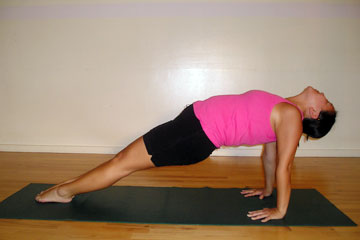
Purvottanasana in Yoga


Purvottanasana belongs to the clan of backward extensions and this week we show the completed pose.

"Purva" means the "east" or "front side" of the body. "Uttana" means "intense stretch." In this pose, the back of the body is extended and contracted while the front of the body is open and stretched.

This pose brings vigor to the spine and a sense of rejuvenation to the spirit. It helps relieve stiffness in the back after practicing forward bending asanas. The shoulders are stretched and opened and the wrists are exercised.

1. Sit on the floor with your legs stretched out straight in front.

2. Place your hands a few inches behind the buttocks, shoulder width apart. Point your fingers forward.

3. Press your palms down to straighten the arms. Rotate the upper arm bones out to lift and fully open your chest, then look at your chest.

4. Keep this open chest as you press your big toe mounds into the floor and lift your entire body up with an inhalation.

5. Lift your buttocks without letting your hips sag. Keep your arms straight. Distribute the weight evenly on your hands and feet.

6. Reaffirm the lift of your chest as you take your head back.

7. Lift the sides of the chest up and keep the shoulder blades into the back so that your shoulders do not round.

8. Now breathe evenly through your nose, feeling an even opening across the front of the body.

9. Stay for a few breaths, exhale and come down. Repeat a few times, working to increase flexibility and stability in the pose while maintaining evenness in the arch of the spine.

Yoga and Indian army

Kavita Suri discovers the new mantra being practised by the Indian army soldiers posted at Siachen Glacier, the world’s highest and coldest battlefield


Do you belong to that generation of young Indians who, after getting inspired by yoga guru Swami Ramdev, have made the ancient Indian health tradition a part of their modern-day stress-filled lives? If yes, needless to ask how yoga has worked wonders for you.
Though it is gaining popularity in recent times, the sages and rishis have been practicing it since aeons at the high peaks of the Himalayas.
And when part of these Himalayan ranges turn into the world’s highest and coldest battlefield, the army has to ensure its troops remain in good health and endure extreme weather conditions. Perhaps, this is the reason why the Indian army has adopted yoga for its troops in the Himalayas.
At heights ranging from 11,000 to 21,000 feet with temperatures that can plummet to minus 60 degrees Celsius, the army troops have started yoga for the past few months at the Siachen Glacier, which is the world’s highest battlefield and also in some other parts of Ladakh.
For keeping good health, yoga is a good option especially since any rapid training exercise in the rarefied air with very low oxygen concentration can lead to physical disorders. Soldiers posted on the icy mountains of the Siachen glacier are exposed to the physical extremes of high altitude and hypoxia, besides the psychological stresses of isolation, monotony, separation from family etc.
In such circumstances, yoga can prove to be very beneficial.
“We recently trained our first batch of soldiers in collaboration with the Morarji Desai Institute of Yoga, New Delhi,” informs Lt. Colonel H. Himashree, Officer in-charge, High Altitude Medical Research Centre (HAMRC), 153 General Hospital of the 14 Corps which is the highest multi-specialty hospital in the world.
Himashree who specialises in high altitude medicine and extreme cold conditions elaborates that they have trained various army units in Ladakh with the help of yoga instructors. These trained soldiers have gone back to their respective units and are now imparting yoga training to other soldiers.
“We are trying to make every unit self-sufficient as far as yoga is concerned,” she says, adding the two month-long training has been especially designed by HAMRC with DRDO (Defence Research and Development Organisation).
There are certain things the soldiers are not supposed to do in high altitude areas when they are inducted in these areas which they however, do not know.
So, nothing is better than a tailor-made yoga package on the dizzy heights of Siachen. The boys also undergo exams, which are both written and practical as well. When they pass it, they become trainers.
Till now, they have trained 102 trained boys with the help of instructors from Moraraji Desai Institute of Yoga, New Delhi at Karu, Partappur, Kumbathang and other areas in Ladakh with different units. These boys are now successfully imparting yoga lessons to the troops in different forward areas in Ladakh.
It is a combination of ‘pranayama’ and ‘asanas’ and meditation.
But even after the training, how successful is the course or training on the glacier where even taking a single step is a big strain in itself?
“Among all the asanas – Surya Namaskar, Pawan Mukhtasana, Padamasana, Dhanurasana, Halasana, that the troops practice at high altitude areas of Ladakh, Pranayama was found to be very useful to the soldiers at the glacier’s top,” says Colonel Himashree.
Five minutes of pranayama, i.e. deep breathing, alternate nostril breathing and abdominal breathing; and five minutes of meditation is working wonders for the troops posted on the world’s highest battlefield.
Confirms an officer Lt. Saurabh Tripathi who has just been de-inducted from Siachen glacier:
“As there is very small space available inside the posts on the top of the glacier, of all the Asanas and forms of Yoga, ‘Pranayama’ is proving to be very helpful. And for that, you don’t need to have more space”.
As the HAMRC is monitoring the progress of the soldiers, the feedback that they get is that Yoga is extremely helpful in high altitude areas.
Those who practise it are well but those who are not are suffering health wise, says Colonel Himashree.
As most of the soldiers give up smoking and alcohol before getting inducted, yoga certainly helps them in maintaining good health for those three months when they are posted here,” informs Brigadier Om Prakash who heads Siachen Brigaden based at Pratappur. Their physical fitness level increases and mental faculties get sharpened.
Yoga reduces wear and tear of the heart and the HAMRC says that its results show that it produces mental tranquillity, greater alertness, flexibility and enhanced tolerance to cold.
“Our objective is the soldier’s ability to survive and efficiency especially on the Siachen glacier where only half as much oxygen as the sea level is available, and the temperatures dip to minus 60 degrees Centigrade,” says Brigadier Om Prakash.
He adds that keeping the troops healthy and fighting fit under such adverse environmental conditions calls for detailed insights into human physiology at extreme altitudes and yoga seems to be the best option in those heights.

Saturday, October 21, 2006

Uthrasan in Yoga

UTHRASANA:

Yoga posture Ushtrasana in a Sanskrit language means a camel, hence the name. The Camel is an advanced and powerful yoga posture, which should be only practiced by intermediate and advanced students in a full version. It opens up the whole front of the body and stimulates the respiratory, circulatory, nervous and endocrine systems.

The Camel pose is a yoga posture that should be done after the body is warmed up sufficiently as it provides a quite deep backbend. The yoga posture is a transition between the simpler prone backbend, the Bow pose (Dhanuranasa) and the more challenging backbend, the Wheel (Chakrasana).

After completing the Camel posture, always release the lower back by going into the counter pose, the Child's pose (Shashankasana) and stay there for a while.

The yoga posture Camel is very beneficial for the digestive and reproductive systems. It stretches the stomach and intestines. This difficult backward bend loosens up the vertebrae and stimulates the spinal nerves, relieving rounded shoulders.

It stretches the spine, back muscles, shoulders and arms. It improves flexibility of the spine and improves posture. It opens the throat as it strengthens the neck muscles and increases blood flow to the brain.

It is a good workout for the ankles, thighs and groins, and it helps to tone the calf, neck and abdominal muscles.

The Camel has many benefits for the practitioner; however, in some health conditions this posture should not be practiced.

Three important reasons (out of many) not to do yoga posture – Camel:

* Anyone with severe back problems such as Lumbago

(Lumbago is mild to severe pain or discomfort in the area of the lower back. It often occurs in younger people whose work involves physical effort but also not uncommon in older age.)

* In case of Hital hernia do not attempt this yoga posture.(Hiatal hernia occurs in the chest area and affects the digestive system.)

* In case of chronic knee or knee operation, or neck injury, avoid this yoga posture

Caution: Always check with your doctor if you have any doubts or concerns regarding the suitability of this pose for you. The reader of this article should exercise all precautions before deciding to attempt this posture and it is best to perform yoga posture in presence of qualified yoga teacher.

Mr.Subodh Gupta, a Corporate Yoga Trainer has conducted more than 500 workshops on Yoga and Stress Management.

Thursday, October 19, 2006

Art of Breathing in Yoga


Hundreds of people gathered at Royal Albert's Palace yesterday to meet the Indian yoga guru Baba Ramdev.


Ramdev is known for healing diseases through Pranayama, an aspect of yoga that deals with breathing.

He runs Patanjali Yogpeeth at Haridwar and has been invited to deliver a lecture at a two-day conference on poverty alleviation being conducted by a standing council of the United Nations. The conference is part of a 2000 U.N. initiative that pledged to eradicate poverty by 2015.

Ramdev spent part of yesterday responding to an invitation by Albert Jasani, owner of Royal Albert's Palace, to speak on "Yoga and Health" at the banquet hall.

Draped in a saffron outfit and wearing wooden sandals, with no coat to protect him from yesterday's chilly weather, Ramdev performed seven exercises of Pranayama in front of the audience of about 700.

"Smooth and long breathing can prevent disease," said P. Ramanathan of Franklin, a yoga teacher who came to see Ramdev and believes in his philosophy of breathing in yoga.

Yoga and Pain Management

Scoliosis affects 2 percent to 3 percent of the population, or an estimated 6 million people in the United States, and there is no cure, the foundation said. Scoliosis affects infants, adolescents and adults worldwide with little regard to race or socioeconomic status.

The primary age of onset for scoliosis is 10 to 15, occurring equally among both genders. The disease can affect the quality of life with limited activity, pain, reduced respiratory function or diminished self-esteem, the foundation said.

Johnson's condition was diagnosed when she was in the 10th grade. She had surgery at age 17 to implant two medal rods to stabilize and straighten her spine. About three years later in 1991, she had the noticeable rods removed, but was then riddled with pain, soreness, numbness and tingling in her back and shoulders.

She learned to live with the pain and thought that it would just be her lot in life. As the pain steadily increased, a friend told her about yoga classes designed to ease the discomfort associated with scoliosis.

"It got to the point where I had to do something," Johnson said. Now at 34, she has learned to manage the pain.

Yoga's benefits and limitations

Valerie Kiser, a Clemmons yoga instructor, said that yoga can be very therapeutic for the discomfort and pain associated with scoliosis.

"I'm not saying it will straighten the back," Kiser said. "Bit it has changed the degree of the curve and reduced the pain by practicing yoga."

Joseph O'Brien, the foundation's president and chief executive officer, said that there can be benefits to practicing yoga. As someone with scoliosis who has had four surgeries, he said he has found some relief with yoga, although he doesn't practice it regularly. "You just have to be careful of what yoga can and cannot do," O'Brien said. "There is no evidence that yoga can reduce the curve or stop the progression of the scoliosis. There is, however, a benefit involved with learning how to breathe, increasing mobility and flexibility."

For Johnson, those are exactly the things that have greatly improved since she started practicing yoga four years ago.

Yoga Can Improve Sleep in Cancer Patients

The first study to look at the use of yoga by cancer patients found the combination of movement and meditation led to better sleep, report researchers at Rice and the University of Texas M.D. Anderson Cancer Center. The small study concluded that lymphoma patients who practiced Tibetan yoga for seven weeks fell asleep faster, slept longer, and felt that their overall quality of sleep improved, compared with a control group of patients with lymphoma who did not practice yoga. Those who practiced yoga also used less sleep medication. The study was reported in the April 15 online issue of the journalCancer.

The study had 39 patients randomized to either yoga practice or to a wait-list. The distribution of cancer stage across the participants was even, and 15 patients in each group were not receiving treatment at the time for their lymphoma. Patients in the yoga group were asked to attend seven weekly yoga sessions at M.D. Anderson. In the patient evaluations, all of the people who practiced yoga said they found the program useful, and more than half said they practiced some aspect of the program at least twice a week during the follow-up period.

Alejandro Chaoul-Reich, a graduate student in religious studies at Rice and co-author of the study, says the results have been encouraging. “This is another way to help with the healing process,” he says. A long-time practitioner of yoga, Chaoul-Reich says yoga can enhance a person’s meditative practice and allow them to be more in touch with their inner self. Yoga also can greatly reduce stress levels. “It is a good option,” he notes, “because you work with your body, energy, and mind. It can help you change your lifestyle. It’s very helpful in the way you live and relate to illness and other people.”

Although the study did not find differences between the groups in other quality-of-life measures, such as anxiety, depression, and fatigue, the study’s lead author, Lorenzo Cohen, indicates this was likely because the study was conducted during a short period of time. Cohen, an associate professor in the departments of behavioral science and palliative care and rehabilitation medicine and the director of the Integrative Medicine Program at M.D. Anderson Cancer Center, says practitioners of yoga told researchers the techniques need to be practiced for at least six months before full benefits can be appreciated. “It’s remarkable,” he says, “that after seven weekly classes we were able to see significant improvements in overall sleep quality across a three-month follow-up time frame.”

Yoga usually includes regulated breathing, moving through various postures, and meditations. The type most commonly practiced in the West primarily comes from the Indian tradition, specifically the form known as Hatha yoga. Less commonly practiced is Tibetan yoga, about which little is known and whose benefits have not been researched, Cohen says. Chaoul-Reich, who led the weekly yoga sessions, points out that Tibetan yoga is different from other forms of yoga because the postures repeat particular movements and the breath is held.

“We believe this form of yoga may be particularly useful for patients undergoing and recovering from chemotherapy,” Cohen says. “The objective of using yoga in patients who have been or are being treated for cancer is not necessarily to increase length of life but to improve the quality of life. In cancer patients, fatigue is not necessarily directly related to the quality of sleep, but given such a small study, the fact that sleep was improved suggests that the health effects of yoga should be further explored.”

An ongoing study by Cohen and other researchers is measuring the levels of stress hormones and immune function in breast cancer patients practicing Tibetan yoga.

The study was funded by a grant from the Bruce S. Gelb Foundation. The co-authors are Carla Warneke and Alma Rodriguez of M.D. Anderson Cancer Center and Rachel Fouladi of Simon Fraser University.