Friday, November 10, 2006

How to start a website on Yoga?

Is it easy to start a website on Yoga?
I came to writing this article specially focus on people interested in starting a website on yoga. Yoga is a practice in which our body and mind get relaxed and maintain our equilibrium by keeping us calm. You like Yoga. You know the importance of Yoga. You want to share this great tool to everybody. You are seeking a method to publish your thoughts on yoga in a website. Then This article is for you.
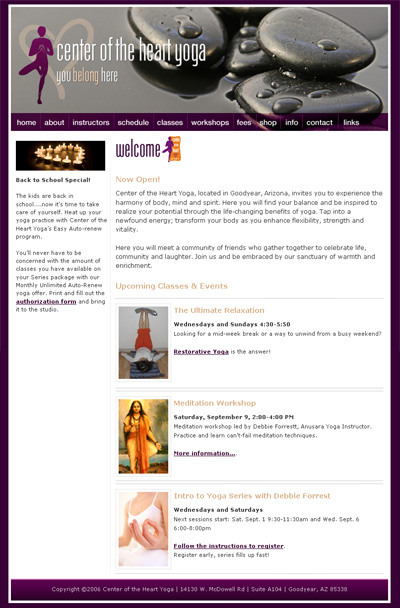
First of all you have to collect relevant yoga content websites from internet. Just search on google or yahoo is not a suitable way to get a list of good Yoga websites. So you need to check each and every website which Google/yahoo listed in their search result page. Then after, develop contents for your yoga website. Arrange your articles in a convenient way. You can make categories like "beginners guide to Yoga", "Different Poses of Yoga", "Advanced yoga poses" etc. Then whenever you publish your knowledge as a yoga article you can put that content on related categories. Hence your visitors can easily browse through your yoga website.

Designing for your yoga website

If you want a good design for your yoga related website, but not know how to design one, just search for yoga templates. In internet there is lot of free yoga website templates already available. Choose one and customise the design for your website. You can also collect various poses' pictures from internet.
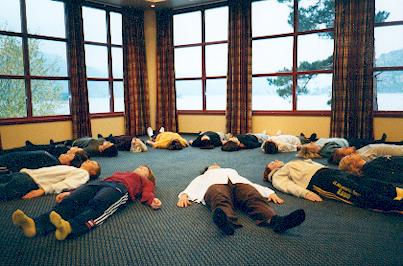
How to Publish Your Yoga site?

After content creation and designing, you can publish your website. Free hosting services are not an unusual thing in this modern world. Pick anyone of the free providers and publish your site. But you must keep an important thing while you are publishing a website.

Do not copy Yoga site content from anywhere.

never copy content from other websites. just copy-paste creation downgrade your pagerank in search engine directories like google, yahoo etc. In the first step I taught you to get an idea about yoga by reading yoga websites. It never mean copy contents from such yoga sites. You have to derive or integrate the content in your own way.

Wednesday, November 08, 2006

How to keep balance in yogasana?

By Kavita Maharaj
[Red Door Yoga]

A concept common to most eastern philosophies, of which yoga is no exception, is the concept of the balanced existence of male and female energy in the universe.

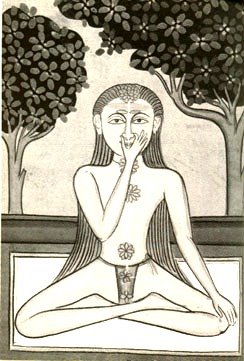
Most of us are familiar with this concept within Taoism, which is represented by the Taijitu or Yin-Yang symbol: a circle containing a balanced swirl of black with a white dot and white with a black dot. Not as many however are familiar with the concept as it appears in yoga, where the concept is represented by a sun and moon together (see illustration).

In yoga, male energy (the sun), is referred to as Shiva, and is the form of the universe. Male energy is the domain of the right side of the body. Whereas female energy (the moon), is referred to as Shakti, and is the force of the universe. The female energy is the domain of the left side of the body.

During yoga practice, the goal is to observe and understand the dance between Shiva and Shakti. In this dance Shiva and Shakti flow in balance with each other bringing balance to the physical, emotional, and spiritual aspects of the yogi.

In yoga, the concept of male and female energy continues on into the categorization of poses as well.

Female poses draw energy into the body and often physically close the body into itself, such as in a forward bend. Male poses on the other hand, expend energy and often physically open the body, such as in a backward bend.

Poses also need to be balanced by male or female breaths.

The exhale of a breath is considered the male aspect of breathing while the inhale of the breath is considered the female aspect.

When practising a male pose, a female breath (inhale) should be used to move into the pose.

If the pose is held for more than one breath, the inhale is then used to deepen a male pose.

When practicing a female pose, a male breath (exhale) should be used to move into the pose.

Likewise, if the pose is held for more than one breath, the exhale is then used to deepen a female pose.

Male and female poses should ideally be practiced in balance with each other.

Interestingly, the pose Savasana, or corpse pose, which is practiced at the end of a physical yoga class is actually neither male nor female, but rather a balanced combination.

After your physical practice, during which Shiva and Shakti have danced in a balanced way, they come to rest together in Savasana.

Thus, while in Savasana, one should focus on a breath balanced through both an inhalation and an exhalation to maintain the flow of both male and female energy.

Friday, November 03, 2006

Yoga and Google Trends

Google Trends is an amazing tool to discover the searching trends in internet. It gives an outline of the keywords people used most often. I just check yoga searching trends from that site. Result it showed is very interesting. As we know, Yoga is originated in India. Same country is still is in eager to learn yoga. Google trends shows that Indian is first in the search for yoga. Second country is Singapore. Canad, USA and Ireland comes next with approximately equal in weight. See the result:


1. India


2. Singapore


3. Canada


4. United States


5. Ireland


6. Australia


7. Chile


8. Switzerland


9. United Kingdom


10. Sweden


While searching google trends with the keyword "Yoga", It also showed city wise Searching behaviour also. San Francisco City is top in yoga search. Delhi city in India comes 5th place. See the yoga trends:
1. San Francisco, CA, USA


2. Pleasanton, CA, USA


3. New York, NY, USA


4. Vancouver, Canada


5. Delhi, India


6. Boston, MA, USA


7. Denver, CO, USA


8. Chennai, India


9. Seattle, WA, USA


10. San Diego, CA, USA


Anyway, all the trend reslts on yoga in Google Trends Shows the increase in interest of Yoga worldwide. SEE Yoga search trends

Wednesday, November 01, 2006

A guide to Beginners in YOGA.

According to a U.S. Consumer Product Safety Commission report, there were more than 3,700 yoga-related injuries costing a total of almost $11 million in medical care in 2004. The most common yoga injuries involve repetitive strain, overstretching the neck, shoulders, spine, legs and knees.

So before you pull out that yoga mat, the American Academy of Orthopaedic Surgeons has this advice.

• Speak to a physician before participating in yoga if you have any preexisting injuries or conditions.

• Work with a qualified yoga instructor. Inquire about experience and credentials.

• Warm up well before doing yoga. Because cold muscles, tendons and ligaments are vulnerable.

• Wear clothing that allows for proper yoga movement.

• Start slowly while you learn the basics, such as proper breathing, before you see how far you can stretch.

• Ask questions if you are unsure of a yoga pose.

• Know your limits in Yoga. Do not go beyond your experience or comfort level in Yoga.

Tuesday, October 31, 2006

Ananda Yogi: A grand master on Yoga

Yogi Ananda, a 72 years old Yoga master started yoga for yogurt.


He is currently teaching the Indian spiritual yoga practice across central New York and in his home studio at White Birch Lane in Auburn. He started his Yoga Journey since his 11th age.

According to him, Yoga is his life, recreation and his socialization. His introduction to yoga came at a monastery in Bangladesh(The eastern area of India). A natural curist doctor offered Ananda a steady supply of sweet yogurt in exchange for every yoga lesson he took. The offer proved too tempting for him to resist.

But he surpassed his taste for yogurt by the his yoga passion. He wandered across India as a monk to learn more about yoga and acquire more experience. Following years of intense study that included eight years of seclusion in a Himalayan cave, Ananda began teaching at the International Yoga Teacher's Training Center in Calcutta. Aspiring yoga teachers came from around the world to be certified by Ananda. Yoga instruction also took Ananda across the globe, from Thailand and Indonesia to East Africa and Spain.


Ananda said that main aim of his life has been to spread awareness about the relation between soul and body by the practice of yoga.

In 1973, Ananda came to America at the behest of the California Board of Education. Board sponsored him to teach yoga at colleges in San Diego, Laguna Beach and San Francisco. Ananda then started yoga classes around the country. After he arrived at Syracuse University in 1974. Students and university staff encouraged him to stay there.

By the end of the decade, Ananda had established the Shankar Yoga Society in Syracuse and instructed celebrities like George Harrison, Peter Sellers and Linda Lavin at the New Age Health Spa in the Catskills.

“They mostly came to lose weight, that's not what yoga is about,” Ananda said with a lightly humorous tone.


Nowadays Ananda concentrates on teaching Yoga at Cayuga County Counseling services and companies like Bristol-Myers Squibb and The Syracuse Post-Standard. He has also conducted a course at Onondaga Community College for more than 25 years. Despite his decades of devotion to yoga, Ananda still shies away from designating himself a teacher.

“The more you learn [from yoga], the more you can then teach[Yoga],” Ananda said.

In his yoga classes, Ananda often uses the operation of a car as an organizing principle for the means of healthy human living he emphasizes. A balanced diet and plenty of water represent the proper fluid levels.

“We try to claim we're eating a balanced diet, but for most people that's a Big Mac in one hand and a large soda in the other,” Ananda said.

Lubrication amounts to rigorous, full-body exercise that loosen the joints and muscles. Breathing techniques, a facet of yoga commonly ignored by other instructors, represent the alternator in Ananda's car model. The exhaust system is comprised of bodily functions and relaxation provides people with a cooling system for the stress of daily living.

“Relaxation is in the mind; it's much more than just laying down,” Ananda advised.

Ananda's holistic approach to yoga contrasts the one-dimensional approach of other instructors. Ananda laments the rising commercialization of yoga, which he believes has brushed aside paramount aspects of the practice in favor of a chic fitness trend.

“One of these days, original yoga won't exist,” Ananda said.

Andanda's approach to yoga extends beyond the muscular flexibility mainstream yoga instructors flaunt. His yoga instruction encompasses philosophy and theology to emphasize the merger of body and mind in service of honesty and selflessness. Getting in shape is only a side effect.

“You can get exercise at the health spa,” Ananda said.

Ananda often encounters this superficial approach to yoga in his classes at OCC. Students who don't take the practice seriously will have a difficult time securing Ananda's approval.

“I want sincerity from my students,” he said.

One of Ananda's most sincere students has been Peter Mack, owner of Mack's Studios in Auburn. Mack began taking private yoga lessons with Ananda almost three years ago after hearing his name mentioned around town. A few lessons later, Mack was a full-fledged yoga convert.

“I was so enamored with it, and it was such a life-changing experience that I kept bringing new people over to try it out,” said Mack, 51.

He continues, “It basically puts all the pieces of your life together - your mind, body and spirit act as one and you feel whole. You find that all the power and the answers you could ever want are inside of you.”

Although Mack has practiced with other yoga instructors, he firmly believes that none can match Ananda's passion for yoga and dedication to its principles.

“He's here for everyone else except himself,” Mack said. “He gives his life to make others' better.”

Mack's comments echo those made about Mother Theresa, who Ananda served alongside on relief missions for victims of natural disasters in India. Today, Ananda's mission to spread awareness through yoga in Auburn begins with ridding his students' “exhaust systems” of the two snacks that repulse him most: soda and gum.

Health Benefits of Yoga

Yoga and meditation has a lot of health benefits such as management of stress, anxiety and improvement of musculoskeletal problems, physical and mental fitness.

Now there’s clinical evidence that suggests that yoga can also be used for reduction of performance anxiety and consequently, be beneficial in enhancing performance in musicians. Dr Satbir Singh Khalsa (PhD), Assistant Professor of Medicine at Harvard Medical School, who has studied the effects of yoga on a group of musicians, has gathered data that proves this.

Dr Khalsa, who was in the city for some days, said, “Musicians when performing in front of thousands of people are faced with performance anxiety. In situations such as these, the relaxation response of the body is not activated producing chronic stress. However, yoga helps them to overcome this problem in many ways.”

Combinations of yoga techniques - “pranayama” or breathing exercises, “asanas” or physical exercise and meditation - helps in the production of Cortisol hormone. This hormone is helpful part of the body’s response to stress.Further, practicing yoga also regulates the autonomic nervous system responsible for controlling stress and anxiety.

Yoga not only catering to performance anxiety, but also helps to remove stage fear through its unique mechanism. Researches on this subject reveals that yoga and meditation helps in reducing stress and the effects of stress.

For instance, Dr Satbir adds: “A research paper on Yoga by Herbert Benson published in 1972, is a strong evidence on benefits of Yoga. It gives the information that Yoga and mediation reduces the consumption of oxygen in the blood, thereby lowering the physiological activity. However, stress is known to have increase physiological activity. Hence, it proves that stress or at least effects is lowered by mediation.”

Apart from secreation of stress hormones, yoga especially if practicised before a particular performance, directs the body and mind to concentrate on a particular thought rather than waving away. Yoga thus breaks the cycle of tension which otherwise builds up in the mind causing performance related anxiety.

Yoga is must in schools: Delhi Government

New Delhi, October 30: Gearing up for the Commonwealth Games, the Delhi government is set to make sports mandatory in schools with each student having to undertake at least one sports discipline. Each school will have to undertake two sports activities and prepare teams for participation in the zonal tournaments.

According to the newly-formulated sports policy all schools in the city must start yoga classes for the “general health” of their students. Schools must find yoga teachers for this Yoga Class. The government will also be planing to reach the private sector for the sponsor of students and sports persons for training for the yoga. The private sector will also help in the sponsorship of sporting events in the city.

According to the Government officials,The State will also try to arrange Arjuna awarders for the purpose of training students and sports persons for yoga in Delhi.

The Delhi government has also proposed job reservations in the government sector for outstanding performers in sporting events as representatives of the Delhi State at national and international sporting events, said sources in the department.

Sources in the Delhi government said that special funds are being kept aside for the implementation of this policy. The policy also proposes scientific research to be conducted by the government to enhance the performance of athletes in the State.

Before a week Mr.Ramadoss, Union Health Minister, talked about the importance of yoga practicing in schools. [See "Yoga is compulsory for schools: Ramadoss" ]

Monday, October 30, 2006

Yoga strengthen your Physical and Mental Health

Whether you’re looking to enhance your cycling performance or to combine the physical and spiritual aspects of your workout, yoga may be what’s missing from your life. Yoga provides balance to your whole being: physical, mental, emotional and spiritual. The question is where to begin?

Roots of yoga

Although there has been a recent surge in the popularity of yoga, scholars believe the foundation of yoga is more than 5,000 years old. Yoga was introduced in the West during the early 19th century as a movement for health and vegetarianism. By the 1960s, there was an influx of yoga schools opening in America and Europe. Today, yoga classes are abundant at health clubs and yoga studios, making it readily accessible.

A consistent yoga practice increases muscular strength and flexibility, improves balance and joint range of motion and enhances body awareness. Yoga positions engage all the joints of the body. A move as seemingly simple as downward dog increases lubrication of the joints, ligaments and tendons as well as providing an excellent stretch for the muscles.

Building a strong foundation

You’re probably thinking, "This all sounds great, but what kind of yoga is best for me?"

Central Coast yoga teacher Laura Ghiringhelli suggests you try a few classes on for size to determine which one fits.

"As far as what type of yoga for cyclists, I think it depends on the intention — endurance, breath awareness, alignment refinement, stretch and balance or spiritual growth? My Yoga for

Cyclists class is a slower-paced class, which takes the time to find alignment and breath, but some people might be more into the flowing more vigorous paced class."

Regardless of which type of yoga class you choose, you will reap amazing benefits. Just remember to listen to your body and go at your own pace. There is no competition in the yoga studio.

Some of the benefits of yoga include:

• Cross training: Yoga serves as an excellent cross-training tool to elongate chronically tight muscles while strengthening weak muscles.

• Increased core stability: Core support allows you to stay stable on the bike and achieve more power with your stride. Yoga teaches how to integrate and radiate from the core, keeping the body supported, yet relaxed.

• Improved posture: Yoga teaches proper alignment of the skeletal system as well as balance and function of the muscles. When you utilize proper alignment on the bike, you will experience greater efficiency and less muscle fatigue.

• Enhanced endurance: Breathing and visualization techniques taught in yoga allow you to focus the mind and maintain a low heart rate, making that century ride seem like a breeze.

Urdhva Prasarita Padasana

[Extracted from star bulletin]
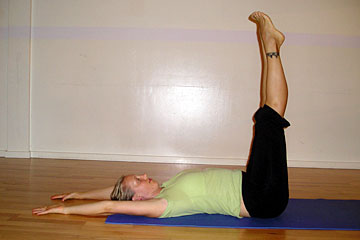
Stage 1 (Upward Expanded Leg Pose) » In this pose, the abdominal muscles are strengthened, and fat around the abdomen is reduced. The abdominal organs become toned and the back muscles are strengthened. This pose helps relieve gastric problems and flatulence.

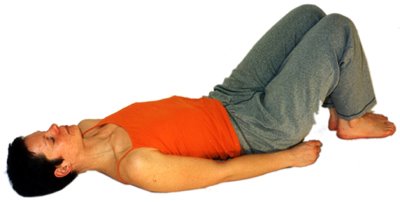
1. Lie on the floor on your back with feet together and body straight.

2. Bend your knees and bring the feet close to the buttocks.

3. Use your hands to lengthen the buttock flesh toward the heels so the lower back feels long.

4. Stretch your arms overhead in line with the shoulders. Keep them straight and flat against the floor with your palms up. Stretch your arms so that your trunk is lengthened toward the arms.

5. Now, slowly extend the left heel along the floor, maintaining that stretch in the back until the leg is straight. Extend the other leg. Both legs should now be straight against the floor.

6. Stretch the arms and legs away from the body and feel the length in the trunk. Do not let your lower back arch.

7. Keep this stretch in the trunk as you bend your knees and take your thighs toward the abdomen. Do not lift your buttocks off the floor or allow your the back to round.

8. Now, keeping this extended spine, slowly straighten the legs until they are vertical.

9. To stretch the spine, extend the arms and press the leg bones away from the trunk. You should try and feel the same extension as you did when the legs were on the floor. Do not let the legs move away from the vertical position.

10. Hold for up to 30 seconds without strain. To come out of the pose, bend the legs, folding the knees to the abdomen, then take your feet to the floor. Rest and repeat. With practice you will be able to hold this pose in comfort, then you will be ready for Stage 2, which we will show next week.

Remember, do not let your face or eyes get tense while in this pose and breathe softly. Learn to focus on the symmetrical performance of the pose so that your mind becomes absorbed in the moment.

Yoga cures Asthma: Yes It Really Works!!!

Asthma is derived from Greek word which means "panting, gasping or short-drawn breath." It is one of the most discomforting of respiratory ailments, known to affect around 5% of the world’s adult population and 10% of children.

Tests carried out at Yoga Therapy Centers across the world have shown remarkable results in managing asthma. In some cases it has also been found that asthma attacks can actually be averted, without the aid of drugs, just through yoga practices.

Since Yoga believes that the mind is central to a diseased condition, pacifying and placating it would, in itself, help cure asthma to a great extent. The practice of yogasanas, yogic kriyas, pranayamas, relaxation and meditation calm down the whole system. This, in turn, facilitates proper assimilation of food and strengthens the lungs, digestive and circulatory system. Over a period of time, that checks asthma attacks and even cures the asthma condition.

Yogic practices result in more anxiety reduction than drugs do. Yoga gives patients access to their own internal experience and helps them pin-point the cause of their ailment, i.e find their own triggers. This comes through increased self-awareness.

Simple Yoga practices help regulate breathing patterns, as well as enhance lung functioning. As a result, asthma patients are able to manage their condition by simply allaying their fears and anxieties.

Yoga also has a stabilizing effect on the body’s immune system. It is now proven that the regular and consistent practice of yoga raises the body’s tolerance to infection as well as its local resistance to infections in the respiratory tract.

Yogic rest and relaxation reduce the nervous system’s overall activity, leading to remarkable recovery. Only Yoga offers resources like Abhyasa (regular, constant practice) and Vairagya (detachment) as means of holistic healing.

The yoga practices for asthma work best on an empty stomach, but you should continue to sip water from time to time, to help keep your airways moist. Wear light, loose-fitting clothes and practice in a comfortable, well-ventilated, airy room or outdoors, with adequate room to lie down. If you experience any symptoms lying down, sit on a chair for a while and rest your head on a table, either on your folded arms or on one cheek. If you feel nauseous, anxious, or short of breath in any of the practices, stop immediately, get up and walk around.

You are probably just hyperventilating and need to burn off some energy. Don't resume your practices right away. Rather give them a break for about a day or two.

Above all, tell yourself from time to time – particularly when you get irritated or upset with yourself – that the way you breathe now is what is making you ill. It is conditioned behavior, which can easily be altered.

SOURCE: Kevin Pederson from yogawiz.com, an online guide on yoga, fitness and wellness.

Saturday, October 28, 2006

Kriya Yoga can help in busting stress- Swami Nityananda Giri

VIJAYAWADA: Kriya Yoga can help in busting stress and the yogic system enunciated by Paramahamsa Yogananda has great relevance for the mankind, said Swamy Nityananda Giri of Yogoda Satsanga Society of India, Ranchi.

Speaking at an inaugural session of the three-day programme of Yogoda Satsanga Dhyana Mandali at TTD Kalyana mandapam here on Saturday evening, he said Kriya yoga was a scientific method of yoga.

Unlike other yogas, Swami Yogananda gave a simple ten-lesson module on how to practice yoga, he said and added that this would help the people in attaining peace and happiness by life energy relaxation.

Friday, October 27, 2006

Free work shop on Yoga

A free workshop on Yoga this weekend in Halifax will explore alternative approaches to physical and mental health.

"Right away, Yoga filters out or excludes a lot of people," Dr. Sodhi, a Halifax psychologist and psychotherapist, said Thursday.

"What we want to do is reach those people who would otherwise not be able to attend workshops like this."

For the first workshop, which runs from 9 a.m. to 4 p.m. Saturday at the Captain William Spry Centre in Spryfield, Dr. Sodhi has lined up three local experts to talk about the importance of tying together one’s spirit, mind and body with the help of yoga.

Dr. Sodhi’s wife, Satpal Kaur Sodhi, will lead a session on using Kundalini yoga to harmonize your endocrine system.

Dr. Jasmeet Chawla, a kidney specialist at Dalhousie University, will speak on controlling hypertension through yoga and meditation.

Dr. Timothy Walker, a Halifax psychotherapist, will talk about how stress-reduction exercises can integrate the body, mind and spirit by using yoga.

All three Yoga presenters agreed to provide their services free, Dr. Sodhi said.

"It will be very relaxed, very down to earth with simple language, very open," he said of the workshop. "After the three yoga sessions are over, the presenters will be available to answer yoga related questions."

Dr. Sodhi said he is confident that participants will leave the yoga workshop feeling better about themselves and eager to take part in future yoga sessions.

"I firmly believe that in every life there has to be a little bit of mysticism," he said. "Otherwise, what happens is you are automatized, you are caged, you are culturally conditioned, and you miss something that we call fathomlessly strange, the other kind of seeing."

About 20 people have registered for the yoga workshop so far, Dr. Sodhi said. He said any interested adults or teens can just show up at the Spry Centre. All they need to bring is a yoga mat, blanket and pillow. Lunch will be served.

Dr. Sodhi, 73, said the yoga workshop is an opportunity for the Sikh society to give something back to the people of Nova Scotia.

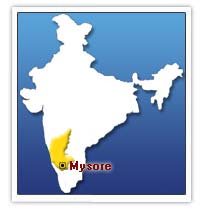
Mysore, a yoga destination for foreigners

The Mysore city has turned into a centre for yoga activities attracting thousands of yoga students and tourists from abroad. Foreigners are interested in practicing yoga from Mysore based yoga centres.

They are arriving in batches to Mysore and Bangalore to learn yoga.

Mysore city alone had 1500 foreigners between September and March to learn yoga from reputed yoga teachers in more than 50 centres spread across the Mysore city. While a few tourists stay one to three months, others stay six months to learn yoga and also teach it in their home country.

Yoga teacher K Raghavendra R Pai said that yoga has gained popularity in recent years. He said that there are more than 100 yoga centres in Bangalore, but the majority come for various reasons, including availability of accommodation, low cost of living and roads free of congestion.

The erstwhile Maharaja Nalwadi Krishnaraja Wadiyar had promoted yoga, he said.

The valedictory function of the Dasara yoga walk will be held on October 29 at 4 pm.

Sri Shivarathri Deshikendra Swamiji will preside over the function. District in-charge Minister D T Jayakumar will release a souvenir. MLA M K Somashekar will preside.

He said that more than 5000 people will participate in the Yoga Walk marathon or Yogathan.

The Yoga pose Crow

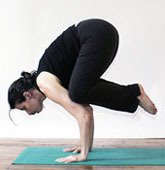
The Yoga pose Crow – (Kakasana, sometimes called Bakasana) "Kaka" means crow (a large black bird with a loud cry) and "Baka" means crane (a tall water bird with very long legs).

The body in this yoga pose resembles that of a bird, thus the names, crane or crow. The Yoga pose Crow is a moderate inverted balancing posture, which builds strength in the upper extremities (arms, forearms, elbow joints, hands, wrists, clavicle, and scapula) and gives you the confidence to begin work with the Headstand and the Handstand.

The yoga pose Crow pose requires courage (to risk falling on your nose) and hip flexibility (to bring the thighs alongside the chest). The Crow is one of the yoga poses that actually looks a lot harder than it really is and it requires much more coordination, concentration and awareness than the muscular strength in the upper arms.

As you hold this yoga pose the chest is immobilized so that you can only breathe abdominally. Remember to keep your attention on the breath because this yoga pose brings the habit of holding the breath as you focus on the balancing act.

This yoga pose reinforces the arm, shoulder and abdominal muscles, wrists and the upper torso. It stretches and lubricates the joints, tendons and ligaments of the upper body. It tones the abdominal organs and opens the groins. The Crow pose increases both physical and mental balance, concentration and tranquility. It balances the nervous system, brings lightness to the body and prepares the mind for meditation.

Although the yoga pose Crow pose gives us tremendous benefits for the mind and the body, in some health conditions this pose is not safe to be performed.

Three important reasons not to do yoga pose Crow:

  • Do not practice this yoga pose if you have a carpal tunnel syndrome (a lot of pain and weakness in the fingers and wrists), as it may aggravate the problem.
  • In pregnancy do not attempt this pose.
  • If you have high blood pressure, avoid this yoga pose.

Caution: Always check with your doctor if you have any doubts or concerns regarding the suitability of this yoga pose for you.

Postures to relax the mind

Courtesy: Bharat Thakur

Sleep is not necessarily relaxation as man dreams, or continues to remain restless during the night. Rest is needed not only by the body but the mind as it works continuously without our control. You cannot stop worrying about a problem even though you know that agonising will not solve it. One way to rest our mind and body is the practice of Yoga Nidra, where a man 'sleeps' and at the same time remains aware that he is sleeping.


Yoga Exercise 1

• Lie on your back on a mat or a hard mattress
• Concentrate on your breath. Breathe deeply from the abdomen and be aware of yourself inhaling and exhaling
• There are sixteen vital points in your body which can relax you totally, if you concentrate on them. Start concentrating on the forehead, move progressively to the nostrils, lips, chin, neck, shoulders, elbows, wrists, fingertips, chest, abdomen, thighs, knees, calves, ankles and toes. Repeat this cycle twice or thrice
• Now imagine your limbs are detached from your body. Only the head, chest and abdominal area exist now. As you breathe in, feel the air entering your spine and cleansing it
• Concentrate on the different vital nerve plexus or nerve junctions called chakras’. Breathe in and out 5-10 times while concentrating on each point
• Start with the root plexus or mooladhara in the space between your anus and your genitals
• Move to the solar plexus or swadhisthan, four fingers above the navel
• Then to the midpoint of the chest, anahat
• Move to the throat, to visudhi
• Move to the point between the eyebrows, ajna
• Finally move to the crown, the suryachakra
• Imagine your limbs are once again attached to your body. Be aware of your whole body as one unit for about two minutes
• Slowly open your eyes, stretch and get up.

C

Thursday, October 26, 2006

‘Yoga causes a positive change in personality, cures many disorders’-Dr Sat Bir S Khalsa

Ludhiana, October 25: Born in Canada and currently working in the US, Dr Sat Bir S Khalsa says the first thing he observes during his visits in India is chaos.

An Assistant Professor of Medicine in Harvard Medical School, Dr Khalsa has come to give a lecture on the effects of yoga at the city’s Majestic Park Plaza.

Dr Khalsa, who had been involved in sleep research, has been practising yoga for the past 35 years and has now undertaken researches on yoga for the past six to seven years.

“I have found yoga causes significant change in the personality of an individual and this can be proven scientifically. In one of my studies, I have observed that yoga caused a fall in the secretion of toxins and hormones which were released due to stress after the person started doing yoga”.

A positive attitute, a sharp mind and active body are some of the effects of yoga, which have been proven and researched in laboratories in India and abroad,

Yoga, he said, was a science and not merely a breathing exercise or gymnastics.

“Yoga definitely gives a spiritual high to an individual and peace of mind and spirituality is attained by even the practice of mere pranayam,” he said, recommending it for everyone.

He also elaborated on the diverse effects of yoga as a source of relaxation, which, he said, caused a positive effect on the autonomic nervous system.

Wednesday, October 25, 2006

The Border Security Force is turning to yoga!


Courtesy: IndiaEnews.com

The Border Security Force (BSF) is turning to yoga to keep its troopers fighting fit.

When A. Jayapaul, a former commandant of the Tripura-Cachar-Mizoram (TCM) frontier of BSF, saw his 'boys' suffering from stress, he decided to opt for yoga therapy.

'We have already introduced yoga during the morning physical training for 500 troopers in the Tripura-Cachar-Mizoram as well as Kolkata region informally,' Jayapaul, a yoga enthusiast himself, told IANS.

Psychiatrist John M. Ralte Long said here that separation from family and relatives could cause mental depression, which could lead to suicide and homicide among security forces. That is why they chose yoga for soldiers.

BSF personnel need yoga practice as they often complain of hypertension, heredity diabetes and other psycho-physical complications due to the nature of their job, which is to guard the country's land borders.

After introducing yoga to personnel in the Tripura area, the troopers started winning medals in the all India BSF athletic competition, Jayapaul claimed.

Said Anil Kumar, a trooper posted in Tripura: 'After practicing yoga, I won a gold medal in the marathon event at the BSF national level competition.'

Added Jayapaul: 'The boys are under duress. The rise in the number of suicides in the different forces is an issue of concern. I believe yoga can go a long way in relieving tension.'

'We have asked the defence ministry to make it (yoga) formal at least for personnel deployed in the far-flung northeast region,' he said.

Yoga helps drive mosquito borne diseases

With 88 fresh cases registered taking the total number of cases suffering from dengue so far to 1,908 in the capital, Chikungunya is playing havoc in south India with over 100 deaths and over 40,000 people found infected.

Yoga has the potential to strengthen a person's immunity to fight a disease like Chikungunya, claims a Yoga instructor in Bangalore.

People who underwent yoga are not attacked by the disease, despite all their family members suffer from it. If at all they get affected by chance, it was cured within three days.

Dengue is spread by female Aedes aegypti mosquitoes, with symptoms such as fever, severe headache, joint and muscular pains, vomiting and rashes. Dengue fever, for which there is no vaccine, causes excruciating muscle and joint pains, high fever and severe headaches.

Like dengue, there is no vaccine for Chikungunya, and at best, symptoms can be countered through painkillers, intake of plenty of fluids and lots of rest.

Though the fever usually resolves on its own within three to seven days but the joint pains persist for months or even years.

Ayurveda need top priority


Udupi, Oct 18: Multi-centre research activities, similar to other medicinal systems, was necessary to make Ayurveda more acceptable, a member of Central Council Committee of Indian Medicine (CCCIM) said today.

"Ayurveda system was left far behind in clinical research activities which needed to be given top priority. Unless documentation and clinical researches were not given priority, whatever tall claims made about finding effective solutions to the diseases like AIDS, dengue fever or chikungunya would get no recognition, Dr S K Bannigol, member of CCCIM said.

Inaugurating a two-day state level workshop on Ayurvedic teaching methodology, jointly organised by the Dakshina Kannada Bharateeya Vidaya Sangha and Alumni Association of SDM College of Ayurveda Udupi, he said Ayurveda study was still 'Charaka-Shushruta oriented' or text book oriented.

"We even could not add anything more to ayurveda through researches" he said adding eductional institutions today needed to be converted into learning from teaching to become more knowledged based.

Over 300 students from various Ayurvedic colleges of Karnataka are participating in the workshop, in which Dr U K Krishna, Director of Institute of Traditional Medicine, Japan, gave special lectures on relevance of Ayurveda in the modern society, orthodox ayurvedic concepts, problem oriented teaching and communication skills.

Lilias Folan's experience in Yoga

BY CECILIA OLECK

[FREE PRESS STAFF WRITER]

Lilias Folan is an expert at journeys.

A renowned guru who helped introduce yoga to Americans through her PBS show, "Lilias! Yoga and You," which ran 1972-92, Folan often spends her weekends on the road conducting workshops for yoga devotees.

When she's not teaching, she's either at her home in Cincinnati or on a journey to her refuge, a 270-acre former sheep farm in Virginia that boasts a Civil War-era cabin made of chestnut logs.

But perhaps Folan's favorite journey is the one she can do anywhere, any time -- the journey into deep meditation and relaxation that she's been on for the past 40 years. She originally turned to yoga as a way to cure what she calls "the blahs."

Folan, 70, will be in Dearborn Heights this weekend to lead a workshop of classes, sponsored by the Yoga Association of Greater Detroit.

QUESTION: You're often thought of as the "first lady of yoga." Yet you got into the discipline in a thoroughly normal way. Can you tell us why you started doing yoga in the first place?

ANSWER: I began my yoga journey in the mid-'60s. Yoga was considered to be quite hippie, but that wasn't why I got into yoga. I went to my family doctor with a litany of physical ailments and he said, "Madam, there is nothing wrong with you -- you're suffering a case of the blahs. You need to exercise."

My back was aching, I had low energy -- taking care of two young sons -- I was tired all the time and smoking half a pack of cigarettes a day. ...

Yoga sounded interesting and a little different. I was curious and those are the kinds of things that bring people into yoga. In 10 weeks, I was sleeping better and in another two months my back felt stronger and six months later smoking gave me up.

Q: Now yoga is one of the most popular fitness trends out there. There are even classes that fuse yoga with other disciplines like tai chi, Pilates, etc. What do you think of its booming popularity -- and the spinoffs it has spun?

A: They're combining two traditions. I like to be clear about yoga and where it came from. It's 2,000 years old. This more contemporary use of yoga, it's fine. I just like to know my roots and where it came from. It's a deep philosophy and a science and study of itself. I've been 40 years on this journey and it's fascinating.

Q: What do you think it is about yoga that someone could practice for a lifetime and not grow out of it?

A: Isn't that interesting? I look at what you just said in wonderment myself and ask the same question. My feeling is that we have a deep wisdom in us that is dormant and it's young. As the years go by wisdom begins to deepen. ... That's the beauty of aging.

How many times can you do a downward facing dog, the basic pose of yoga? Well, it's deepened. There's a wisdom that has deepened as we practice.

By wisdom I mean that if there is an anger or fear that comes up, I can let it go by. I don't have to hold onto it.

Q: You focus a lot on helping middle-aged and older people discover yoga and your most recent book is "Lilias! Yoga Gets Better with Age" (Rodale, $22.95). What are some of the benefits?

A: What I do is say mid-aged and beyond. I'm sensitive about that. ... I have older students and I have students of all ages, size and shapes and all degrees of experience and I love that. I want to help people take the first steps with yoga.

It's easier to walk, stand, sit and sleep. ... I think mid-aged and beyond are looking at ways to maintain our health in our maturing years.

Q: What should someone look for in a good yoga instructor?

A: If you feel well and happy and energized at the end of the yoga class, chances are you are in good hands. In today's yoga world, many teachers are registered with the Yoga Alliance and that requires 200-500 hours of study. I'm a member of that. I'm an E-500 registered yoga instructor.

Q: What is a 1-minute vacation?

A: It's an experience that I bring into a yoga class. You just close your eyes and go into vacation mode.

What do you do when you're on vacation? If you're on vacation, you sigh, you say, "Isn't this pleasant?" You smile. For 30 seconds you just are on this desert island and it's the oasis within you.

Q: How often do you recommend that people do that?

A: If we think about it once a day, we're doing darn well. That's the good part of our yoga classes -- taking some nourishing part like that and putting it into your life.

Q: What would people be surprised to know about you?

A: One, I love to learn Italian. I love Italy and I love the language and I study Italian. Two, I love opera. I love to study opera and I love learning about it. Those are two of my passions. And I guess it's pretty obvious -- I adore my seven grandchildren.

Q: How has the practice of yoga changed over the years?

A: Big changes, big changes. One is that in the '60s everyone did the yoga postures the same way ... every age, no matter what, everyone did the postures the same way.

And frankly there were a lot of injuries. And that's where my teaching started to flower because I could see that there were problems.

Today there is alignment, props, consideration for age, yoga therapy. ... Now today there are many cautions. "If you can, do it this way, try it this way." There's also a huge respect from the medical community for the value of yoga postures, breathing and relaxation in managing stress.

It really is detrimental to your health to stay in a toxic body. And it's easy to turn around and it's fun. ... I want to have a good time. The joy is in the journey.